Tuesday, April 30, 2013

Harry Potter Project: The Beginning

Spinning Straw into GoldWelcome to the grand beginning of the Harry Potter Book Club!

The project has been in the works since late December when I announced my lofty goals for the year, one of which was to read the entire Harry Potter series and blog about my impressions.  The idea was met with considerable enthusiasm.

Almost five months later, here we are!  Jenna of A Light Inside is acting headmistress of the project, but you can find the discussions headquartered here and over at Cyganeria as well.  There promises to be a lot of fun and games in addition to serious scholarship and close reading, and there should be something for everyone.  I hope you'll join us.

Click on the spell bellow to begin at A Light Inside with a more thorough introduction and insights into Chapter 1 of Harry Potter and the Sorcerer's Stone:


Consider it your syllabus to this introductory course in magic.  Then hop back over here for my reflections on the first chapter.  And keep a look-out for the third and final introduction from Masha at Cyganeria toward the end of the week.


Before You Read


Please note that I am reading the American versions because those are the copies to which I have access.  Hence I'll be calling the first book The Sorcerer's Stone, though it's original title is The Philosopher's Stone.  I'd love it if a British reader could share significant differentiations as we go along, however.

Additionally, here are a few things you might like to have for the Harry Potter read-through:

  • some used or cheap copies of the books that you don't mind jotting notes on and stashing into your purse or the glove compartment of your car
  • a small notebook if you can't get access to the above
  • candles for late-night castle reading
  • a Latin-English dictionary for deciphering spells (and making up your own!)
  • a cloak of invisibility for hiding from Muggles while reading
  • wizarding music (soundtrack/playlist--compiled by yours truly--forthcoming)
  • wizard recipes for delicious and subject-appropriate snacks (also forthcoming from Masha!)
  • a mythology or Harry Potter reference book

If there's anything else you think should be on the list, let me know and I'll add it!  Now that that's covered, it's time for . . .


The Beginning


Minaali Haputantri Photography

A wise person once said somewhere that the best place to start is at the beginning.  It's impossible to read the first page, the first paragraph, the first sentence of Harry Potter and the Sorcerer's Stone without an inkling of what you're getting into:

Mr. and Mrs. Dursley, of number four, Privet Drive, were proud to say that they were perfectly normal, thank you very much.

Methinks the lady dost protest too much.  Right away, we know this story is going to be out-of-the-ordinary.

"The Boy Who Lived" scores well in my book for first impressions.  It's characterization of a boring, straight-laced, rather self-centered English family is affectionately disapproving and puts me in mind of the children's  books of Roald Dahl and his successor Lemony Snicket.  I agree with Jenna that a children's story that only engages children is not a very good children's story, and this chapter engages the reader's curiosity and imagination.

Jenna mentioned that the wizardry in Harry Potter is a spoof, and this too may account for the immediate familiarity and the ease with which I slid into suspension of disbelief.  Short bearded men in cloaks and bespectacled, black-haired, tight-bunned ladies who turn into cats.  Who doesn't have some fond memory of such things, woven in the background of their childhood so intricately and seamlessly as to be almost invisible?  But it's more than that.  The confidence with which the narration is presented is conversational, a kind of "what you are about to hear are real events" tone of storytelling.  I love that, that awareness of story as story.

As someone trained in literature and an amateur writer myself, I noticed things like simple diction, trite turns of phrase, and tendency to rely on adverbs.  But I've never been a fan of the high-brow literary school of critics--why can't plain but clear writing, as much as beauteous writing, be an effective stylistic choice?--and when I try to imagine HP written in a florid post-modern voice, it looses an essential quality I can't quite put my finger on.  Perhaps because the subject of the story is already eccentric.  The simple writing presents what would otherwise be a fantastical account of events in a fairy tale-meets-the-evening-news mode.  It also gives us a sense of the narrator, of ourselves as readers--again, that story-as-a-story effect--that stronger writing would take away by making the characters too immediate and the story too immediately immersive.  Though, don't get me wrong, I expect to be drawn into it more and more as it moves along and I get to know the characters better.

Cory Godbey

Other first impressions:

This Dumbledore is a stand-up kind of guy.  He's not a Gandalf wizard by any stretch, which is refreshing in this age of copycats.  He reminds me more of your favorite high school teacher who pretended not to know what was going on in his classroom when his back was turned to write on the blackboard, but who would surprise you with a knowing and relevant comment in passing when you least expected it.  You sense depths of knowledge and emotions to which you have not yet been granted access in confidence.

While Dumbledore conjures distance under a reserved silliness, McGonagall keeps us at arm's length with her prickly manner.  One thing in particular I didn't like was her comment about even stupid humans noticing all the strange things going on.  Yet after giving it some thought, and Rowling the benefit of the doubt, I considered the following.

Perhaps we are meant to be drawn into the realm of wizardry from the world of the under-ordinary, in the sense that we readers are confidants--even artists.  Our art is in recognizing the mysteriousness and wonder of existence in a way that sets us apart from others.  It is what makes us readers, seekers of fiction, and friends of the imagination.  Our very act of reading initiates us in a sense, while the Muggles are those of us who fail to recognize and seize upon the type of magic in everyday living; who reject imagination and fiction as children's stories, invaluable to the real world; who go about day by day like Mr. Dursley, unable to fathom that perhaps the homeless man at the street corner is a wise and benevolent wizard, much less a dignified human being.

Maybe the wizards in the universe of Harry Potter are those of us who are not blind to the greater struggle going on, outside our self-satisfied, comfortable, and sometimes mundane lives.  I suspect anybody who can be open to the type of love-magic and truths spoken in Harry Potter, or any fairy tale, would be a wizard within its pages.

Last, you have "the boy who lived."  Jenna makes an astute distinction between "lived" and "survived."  That one word turns the meaning of the entire story.  And while I am worried, with Professor McGonagall, about poor Harry growing up among those atrocious relatives; and a bit distanced by the main character already being introduced as not-an-ordinary-person (how do I relate to that?); I feel a bubbling hope with its source in the little baby left on the front step of number four Privet Drive.  Who sleeps peacefully in the night not knowing how important he is or how his being in the world is a sign of hope to so many; and I am reminded of the dark of early Christmas morning, with dancing stars and strange learned men who show reverence in secret, when another little baby came quietly, unobtrusively, to change everything forever.


fleur2

Friday, April 26, 2013

Fourth Friday Fairy Tale Prompt: Volume 3

girl with a red umbrella, by takmaj of deviantART

It's that time of month again: time for the Fourth Friday Fairy Tale Prompt!  This is an exercise in support of the fairy tale writing community and online fairy tale community in general, to offer encouragement, creativity, inspiration, and fun.  I hope you'll join us this time.

How to Participate 


  1. You have until the fourth Friday of next month to use this prompt to inspire a piece of art, music, or writing.
  2. Your piece does not have to be supernatural, as long as it is inspired by the fairy tale prompt.
  3. Post your finished piece on your blog, site, or other online presence.
  4. Link your virtually published piece to this post.  (See inlinlz tool at the bottom.)
  5. Read (or view) the other entries.  Offer insights, appreciation, constructive criticism, and encouragement.  Have fun.
  6. Use the following image in your post and link back to this post so that other people may find us and participate in the future.
 

People's contributions continue to impress me, so I am looking forward to this round.  Please e-mail or leave a comment if you have any questions.


*  Please give credit for the prompt.  Not under any circumstances is the prompt to be used for personal monetary gain; it is the rightful creative property of another.  Nor does Spinning Straw into Gold receive any compensation through the use of these prompts.

fleur2

Coming Soon!


Click to enlarge.

fleur2

Wednesday, April 24, 2013

Not the Book by Phillip Pullman

Just sayin'.


Is this the world's shortest fairy tale?  The Grimms' The Golden Key is reproduced here in full for your enjoyment, translated by D.L. Ashliman.

Once in the wintertime when the snow was very deep, a poor boy had to go out and fetch wood on a sled.  After he had gathered it together and loaded it, he did not want to go straight home, because he was so frozen, but instead to make a fire and warm himself a little first.  So he scraped the snow away, and while he was thus clearing the ground he found a small golden key.  Now he believed that where there was a key, there must also be a lock, so he dug in the ground and found a little iron chest.  "If only the key fits!" he thought.  "Certainly there are valuable things in the chest."  He looked, but there was no keyhole.  Finally he found one, but so small that it could scarcely be seen.  He tried the key, and fortunately it fitted.  Then he turned it once, and now we must wait until he has finished unlocking it and has opened the lid.  Then we shall find out what kind of wonderful things there were in the little chest.

This needs no other commentary than this: it was historically always placed as the last tale in the collection.

fleur2

Thursday, April 18, 2013

A Few Fairy Notes

1.  With the disappearance of the classic SSiG background, I'm revamping the imagery; so please bare with me and the shape-shifting blog for now!

2.  My poem "Achilles's Sister" was published in Fickle Muses.  Click the link to read.

3.  A new fairy tale publication is being released by the editor of Enchanted Conversation, Kate Wolfold, brought to us by World Weaver Press!  Beyond the Glass Slipper: Ten Neglected Fairy Tales to Fall in Love With introduces a collection of lesser known tales with the non-tedious yet intelligent blend of professionalism and personability with which Ms. Wolfold mans Enchanted Conversation.


In honor of the book's release, World Weaver Press is hosting a Fairy Tale Festival until May 6.  Go and join the fun!  And purchase the e-book because EC will be hosting a group discussion on the book you won't want to miss out on!

fleur2

Monday, April 15, 2013

What I Mean by "Merrie England"

A lot has been said about why fairy tales take place "once upon a time."

The consensus, at least as I have seen it, is that the vagueness allows the fairy tale to take place at all times and any time, making it accessible to all people throughout the ages.

It also shows that the "once" and the "time" of the story are parallel places and times, a fantasy world where we are asked to suspend our disbelief and play along with the magical, absurd, and pure evil things that can and do happen.

The idyllic pastoral way of life depicted fancifully in fairy tales is hard to pinpoint historically, though research like scholar Ronald Hutton's shows that some aspects of Merrie England did exist before Puritanism.


While "real" life--as opposed to reality in fairy tales--is far more complex (those that  mean us harm are not clearly ugly; goodness does not shine through a benefactor; and justice is never quite as satisfying), fairy tales distill truths about our living world.

Skeptics scoff to call anything magical, but what is the birth of a child?  In this context, the word "magical" falls way short of the mark.  So in fairy tales, a train of fairies and angels attend a baby's christening.

Trees die and drop their leaves in the fall but resurrect in the spring, when blossoms appear on their branches.  So in fairy tales precious gems grow on trees and gardens bloom overnight.

Men kill other men without reason, and through violence and disease our loved ones are robbed from us before their time.  So in fairy tales, hideous trolls live under bridges and obstinately block the way, frustrating the crucial journey.

But I believe in the Merrie England of fairy tales in yet another way.  Its no-time-but-any-time-and-all-time suggests there is reality outside our senses.  If it isn't historical it is because it transcends history.  Something of this effect is tackled by Charles Williams in his Arthurian cycle, in which a Utopian Logres peaks for a time as part of a larger empire.  In The Lord of the Rings, the wisest and saddest of characters are always looking West, either for a sunken Atlantis or Blessed Realm with fragile ties to the physical world.

Boucher, Shepherd piping to a Shepherdess

Michael Moorcock critiques the worldview incarnate in Merrie England as having no place in modern fantasy.  On the contrary, I think fantasy in any other context is just pageantry, flashing magician's tricks and astounding colors, entertainment without substance.

Merrie England stirs in us two things: (1) the idea that common and everyday occurrences have deeper meanings and (2) that the reason we are restless is because there is an ideal world (whether it existed or not, whether it can be achieved or not) for which our hearts ache.

Saturday, April 13, 2013

Spring Again

"It is spring again.  The earth is like a child that knows poems by heart."--Rainer Maria Rilke

I didn't make it to the Ren Faire this year, but if you live in certain parts of the country, you may find a festival more tailored to your tastes anyway.

My friend told me about The Faerie Folk Festival held in New Hampshire each spring, and it's highlighted even is the building of fairy houses!


I wonder what other fairy festivals can be found in pockets of countryside on both sides of the Atlantic this season.  But hey, you don't need an excuse to go on a fairy-watching picnic in the meadow or build a tiny dwelling for visitors to inhabit.

fleur2

Wednesday, April 10, 2013

Guest Post: Literature's Handmaid

by Ellie Peck


[Dear readers, Ellie has allowed me to publish this essay that originally appeared in Soul Gardening, a mother's journal of literature, poetry, and an artistic, holy lifestyle.  It's directed to parents or educators of children, but as these things go, anything that is significant as regards the formation and evangelization-of-the-imagination of children, has to do in a profound way with humanity as a whole.  Especially as the just-emerging adult generation is losing its ties to the storytelling and mythic tradition.  And there's a neat review of a much-loved story and much-honored artist.  We really need, as a society, to read out loud again.  Enjoy!--C]

There are some people, whom I respect greatly, that belong to the camp of “Mythology is purely pagan nonsense that has no business in the formation of children.”   The aim of this article is not to refute that point.  While I personally think it can be done, I don’t want to fritter away my energy in a mythology apologia.  I will however, for the sake of warming you skeptics or fence-sitters out there, say a few words that may cause you to give a longing look at the green grass on my side of the fence . . . one where fantastical, mythological and nonsensical stories are told in abundance (provided the concepts of Good and Evil are presented in clear, proper positions--a whole ‘nother topic).

K.Y. Craft

First we look at the pure logic in it.  Mythology, like it or not, has a rich history in our culture and references to it abound.  I pity the day that will come, and perhaps already is here in some cases, where people will make a reference to Pandora’s Box or Achilles' Heel and receive nothing but quizzical looks or blank stares in return.  William F. Russell makes this point in the introduction to his excellent and highly recommended book, Classic Myths to Read Aloud and goes on to say:

Children are constantly trying to make some sense of their world, and when they are allowed to acquire a store of traditional information, when they are given meaningful reading materials that draw upon that store of shared knowledge, children (and adults too) are able to create mental “hooks” on which they gather and attach new pieces of information.

He goes on to lament how two college students (headed to the Education Department) were overheard trying to make sense of “the wooden horse of Troy” and “And who in the world is this guy Troy, anyway?” Oh, how the literacy policewoman in me wants to weep!

K.Y. Craft

More than just staying on top of important references, the tales of gods, goddesses, heroes, wars, love, and tragedy in mythology have delighted people for generations.  They teach many good lessons, they stir up emotions, they inspire meaningful discussions and they expand vocabulary.  And you will also find that the added bonus of understanding stories behind many of the sky’s constellations is quite satisfying for children too.

Onward now.  I can share a bit about a gorgeous children’s book that may whet your appetite for more mythology.  Apart from a couple compilations (like the superb D’Aulaire’s Book of Greek Myths), there are only a few titles in the picture book world that directly tell traditional mythology tales.  But the story Pegasus told by Marianna Mayer and illustrated by K.Y. Craft is in the top of its class.  The first thing you’ll notice about this book is it’s incredible artwork.   Each page deserves its own frame and lingering moments.  I love when a story devotes the occasional, two page, wordless spread to illustrating a piece of the story.  Kinuko Craft is a sublime artist who has won more than a hundred graphic-arts awards.  Incidentally, she chooses her commissions well because all of her children’s books are worthy of looking over; they are fairy tales or mythological tales (e.g. The Twelve Dancing Princesses, King Midas, Tom Thumb, etc.). The work she puts into the story of Pegasus draws you right in, makes you feel the fear of the chimera, the indifference of the villagers, and the nobility of Bellerophon.   Mariana Mayer does an excellent job of staging the story and staying true to its meaning.   There are many little tangents available for further research if you are so inclined.   The names are difficult to pronounce, some of the relationships are taken for granted, but with a perceptive reader (someone who speaks in almost a slow whisper when Bellerophon first sees Pegasus or who raises her voice in excitement while the battle blows are told), children fall deep into the spell of the story and are left a little bit thoughtful by its ending.


My children may not go through life knowing all of pop culture’s references (that’s fo-shizzle), but they’ll definitely not go into college wondering ‘who’ in the world Troy is.  I’m determined to stoke the fires of their imagination with the great stories of Greek and Roman mythology.  And I have great satisfaction when they try to make Orion out of the glow-in-the-dark star stickers in their bedroom. . .

“For Mythology is the handmaid of literature; and literature is one of the best allies of virtue and promoters of happiness.”--Thomas Bullfinch

Ellie Peck blogs about children's books at www.bibliozealous.blogspot.com.

fleur2

Tuesday, April 9, 2013

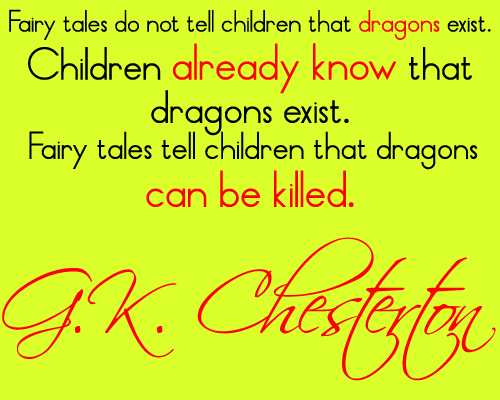
Dragons Exist

I step away from the blog for a mere three weeks and the background has disappeared!  It must be the internet elves up to no good again.


Writing is taking over my life momentarily, so now would be the perfect time to publish a guest post on Spinning Straw into Gold.  You may advertise your blog, publication, art, or anything else you like provided it has some connection to fairy tales and mythic art and provided that your post is not exclusively about the advertisement.

E-mail me at GreenInkling@gmail.com or leave a comment for more info or questions.  And bear with me while I sort out this background issue.

fleur2