Showing posts with label Hans Christian Anderson. Show all posts

Tuesday, January 29, 2013

Mercy Killing

I have a two-year-old.  We were watching the Baby First television channel together this morning at my parents and, not for the first time, we saw Baby First Tales, a series in which "9 classic fairy tales are retold and reinterpreted just for little ones."

This morning, it was Hansel and Gretel.  Here's Rumpelstiltskin.


I don't have any feeling either way with the series's sanitizing fairy tales to make them "appropriate" for the youngest of "readers."  We've been doing that for centuries now, ever since fairy tales started to appear in print.  It's the decision of a discerning parent if he or she wants to expose little ones to the sometimes scary realities of fairy tales--because in truth, that's what fairy tales do.  Expose us to realities (good and bad, the depraved and the beautiful) that we aren't mature enough to understand, or may never really understand.

But these stories have so very little in common with the eerie and sublime fairy tales from which they take their names.  Why bother calling them retellings at all?  Why not make the final jump and change the name of the characters?  It's not like a candy-made house or a difficult to pronounce name, in and of themselves, are an intrinsic part of fairy tales.

And that's just it.  I'm not offended that my beloved fairy tales have been altered beyond recognition.  I just don't consider them fairy tales.

As for my son, I continue to read fairy tales to him, in children's books that loyally translate the Grimm's versions into easy-to-digest prose, with pictures.  Straight from my collection of Hans Christian Anderson.  And from my own memory.

Obata Takeshi
(Do click on the picture to enlarge it; it's extraordinary.--C)

It is important to me that he is told fairy tales.  Not a neat lesson wrapped up in a fairy tale package, but the real, true, uneasy experience.  I'm not going to shelter him in this sense, and I don't think I need to.

The uneasiness seems to come to older children or adults who have not been read Grimms, Perrault, or Anderson, when they first hear about them.  Or to adults who sit down to analyze their favorite childhood fairy tales for the first time.

Young children who are exposed to fairy tales for the sake of hearing fairy tales, on the other hand, handle them pretty well.  Witch cannibal in an oven?  Natural.  Queen forced to dance in hot iron shoes?  What else would you do with a sociopath stepmother?  Let her plead insanity and sentence outpatient services?

Chesteron, as usual, sums up my entire feeling on this in one phrase:  "Children are innocent and love justice.  Adults are wicked and prefer mercy."

fleur2

Friday, December 14, 2012

On "The Snow Queen," Part 1

Shards of Glass


The Snow Queen by Hans Christian Anderson is my favorite, right up there with Rumpelstiltskin.

This unusually long fairy tale grasps hold of the imagination with something inherently wondrous and magical--snow--as well as a vast northern landscape, a turn of seasons, a queen of merciless nature, and a brave and strong little girl determined to find her best childhood friend.


source

One might be confused, then, when The Snow Queen begins with a tale that seems to have little to do with what the title suggests.

The "First Story"* tells of a "real demon," who takes delight in wickedness and creates a mirror in which all good things it reflects are distorted.  He and his fellow demons, in their pride, decide to carry the mirror up to heaven, to mock even the angels, but the mirror is far too heavy for them.  It slips and falls to earth, shattering into infinitesimal pieces that lodge into the hearts and eyes of human beings.

Some of the fragments were so big that they were used for window panes, but it was not advisable to look at one's friends through these panes.  Other bits were made into spectacles, and it was a bad business when people put on these spectacles meaning to be just.

On The Snow Queen annotations of the web's number one fairy tale resource, SurLaLune, Francesca Matteoni provides interested readers with some context:

The looking-glass is a recurrent symbol in fairy-tales, see for example Snow White.  In this specific case, as Lederer notes, the reflecting surface can represent the illusion of the senses in which the reality of the soul is misshaped.  A similar concept is traceable in the Gnostic doctrines, according to which God was not responsible for the creation of the world: the earthly world was in fact the result of a separation from the realm of the spirit, and of the illusory work of an evil demiurge (Lederer 1986, 6-7).

This is very interesting, especially, as Ms. Matteoni mentions, because mirrors appear so frequently in fairy tales.

When I first read about the distortion-mirror, however, it didn't seem to me that the mirror revealed the untrustworthiness of the five senses.  Rather, I thought this was an ice-clear commentary by the author about the taint of the fallen human soul.

Nika Goltz

Readers of Dante and Milton, or even those passingly familiar with the western classics, might recognize the shattering mirror, the demons' pride and their fruitless revolt against heaven, as a "mirror-image" of the Fall.  The bits of glass that scatter to earth and that later contaminate little Kai are like the residual effects of that fall, be it original sin, concupiscence, or what have you.

It's not literally Kai's eyes that are the distorting instrument, but the illusory mirror which transforms the physical things--things that are real and in the temporal world, like the children's roses--into ugliness.

Perhaps Anderson meant the mirror as commentary on the politics of his day, perhaps of people that he knew, but more than that, of human nature itself, of people who, for whatever reason--be it a grudge, bigotry, jealousy, or a sense of entitlement--view their fellow human beings through a distorted lens.

Everyone probably knows one or two of these people.  Maybe they are the kind of people whose mouths are always ready with complaints, who don't know how to take a compliment and are quick to judge and mistrust, or insist that "all the best people [become] hideous, or else they [are] upside down and [have] no bodies."

At any rate, it prepares readers for little Gerda's redemption-esque quest to restore Kai to innocence and safety.

What were your thoughts, if any, on the introduction to this classic Anderson tale?  Am I wrong about the symbolic role the mirror plays in the First Story?


*  I quote from the 1988 edition of Anderson's Fairy Tales by Children's Classics, which uses a translations from the first quarter of the twentieth century.

fleur2

Thursday, July 12, 2012

A Fairy Tale Find

I purchased this hardcover, illustrated volume of Hans Christian Anderson's fairy tales for five dollars at an antique shop today.
InstaCam_2012-07-12_12-00-31-PM
InstaCam_2012-07-12_11-52-38-AM
Can you believe someone would give this up?

Tell me about your awesome fairy tale finds.  Do you collect fairy tales, either in a publisher's series or individual volumes?  Is there a particular translation (or translations) you prefer or recommend?  What is the ultimate deciding factor for you in determining whether or not to purchase?

fleur2

Monday, June 4, 2012

Classic Anime Fairy Tales

Today is my 27th birthday, if I may divulge my age.  I therefore think it appropriate to indulge a little nostalgia.

Like most little girls, my early childhood was dominated by Disney fairy tales, but they weren't the only ones.

A few non-mainstream movies sidled in there beside the squatting Disney giant, and the ones that gave me the most lasting impressions were the Japanese animations.

It's undoubtedly a matter of taste, but I find the Japanese's graceful animation style much more suitable to fairy tales than Disney's more exaggeratedly cartoonish rendering (not so bad at first with Snow White and Pinocchio but growing more over-the-top in the 80's, so that after The Little Mermaid, we now have highly stylized pinched waists and hulking shoulders in Hercules and Tangled).

I also find (correct me if I'm wrong) that the Japanese are less loath to present troublesome subjects to children, so that their fairy tales remain closer to the originals.

Like Hans Christian Anderson's The Little Mermaid:
While there is a talking dolphin (it's not out of the question to assume that in Anderson's vision, mermaids regularly conversed with the ocean locals), his cuteness is considerably blunted by the fact that he is carrying a knife with which to murder the prince.

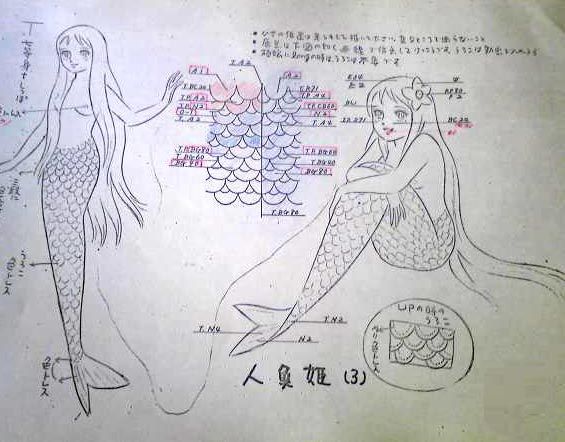
In the conceptual drawings for this movie, they show the mermaids bare-breasted and went forward to animate them accordingly.  In the English dub, however, all the "revealing" scenes are deleted.
images courtesy of The redanimation blog
Swan Lake was another one that imprinted in my mind, so that many years later, after the introduction of YouTube, I would go in search of it to sate my nostalgia.

In contrast to this version, The Swan Princess is not Disney-made, but it follows the well-forged path by grafting on musical numbers, humorous animal helpers, and an uncompromising, happy ending.

The Japanese animated Swan Lake differs drastically in plot and mood.  Though squirrels narrate and follow the tale, this is not entirely outside of fairy tale fashion, as in Anderson's The Swamp King's Daughter.

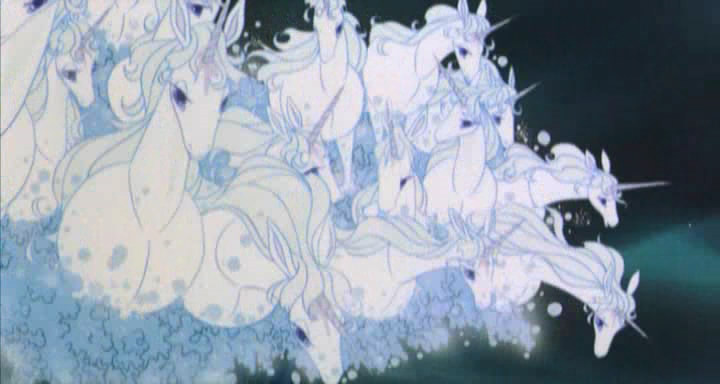
And who could forget the enchanting animation for Peter S. Beagle's The Last Unicorn, an example of the rare (though growing more common) American anime?

This foaming, rolling wave, curling into a host of galloping unicorns emerging from their black sea-prison is one of the most memorable scenes.  Talk about moments of perilous beauty encountered in Faerie!
This next one was a later discovery for me, but there are some real elements of whimsey, such as the fire children plucking and lighting flowers.

I like the inversion of the characters' elemental colors.
Apparently, The Sea Prince and the Fire Child is based on a Japanese myth and Shakespeare's Romeo and Juliet.

I'll deal with Disney and why I'm not overly fond of their re-tellings in the next couple of posts.

Hey, and if you want to gift me a free birthday present, it's as easy as leaving a comment!
fleur2