Showing posts with label popular culture. Show all posts

Monday, June 19, 2017

I Want Out of the Woods

A Review of Into the Woods


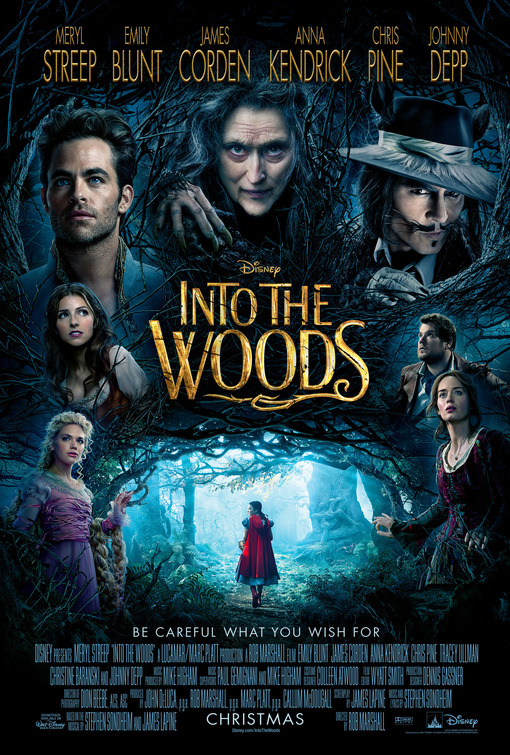
Admittedly, I know nothing of the musical Into the Woods besides a heavily edited high school performance seen well over a decade ago.  It didn't make an impression then either.  The premise of the story, an intertwining of plots and characters from several fairy tales (Grimm originals, to boot), seemed promising.  That and the the all-star cast line-up enticed me to click play while I was browsing Netflix one evening.

source

The beginning is the best part of the whole film.  It only goes downhill from there.  The way the stories wove together were, well...passable.  And that's the best I can say about it.

I liked the setup, placing the baker and his wife into the Rapunzel tale.  The expectation of things coming together, especially the opening song, had my attention.  Emily Blunt performs very well as the Baker's Wife, combining musical dialogue with humor.  I'm fond of James Corden and pleased with his casting.  Little Red Riding Hood's introduction as the glutton is cute as well.  Interesting parallels there between her and the wolf.

As the movie played on, I felt a gaping lack of attachment to the characters--other than Mr. and Mrs. Baker: infertility is a profound struggle that touches far too many.  And Emily Blunt carried that for me.  The princes bored me to tears.  Rapunzel was a nobody; Cinderella was, as the witch says, merely "nice;" and the children are downright annoying.  Is the head-slapping relationship between Jack and his mother supposed to be endearing?

source

Meryl Streep's character is meant to express moral ambiguity, I get it, but there should have been some sort of tie-in between the bakers' infertility and her kidnapping the baker's sister to be her adoptive daughter.  What we get is tiresome sung-exposition.  Insert the Willy Wonka Gene Wilder meme here:  Tell me again about the complex parent-child relationship that plays out in complex ways and is complex!!!!  The witch having never previously expressed a desire for a child and the total lack of screen time between her and her "daughter" killed the effectiveness of any would-be emotional impact.  We could have done with a little character development.

source

In the end, the characters all work together and all get their wishes.

But--this musical wants to slap it into our heads as surely as Jack's mother--you should be careful what you wish for.  After the curtains close on the traditional endings, there is still another dragging hour of  movie left; during which, in-between trying to avoid the wrath of a giantess, they all come together to be communally unsatisfied.  A theme that feels heavy-handed and forced, desperate to join the lineup of postmodernist deconstructed fairy tales.  The deaths are stupid and pointless.  The ending utterly anti-climactic.  Into the Woods tries be profound and it's just not.  Somehow, that is worse than if they'd decided to say "sod it all!" and just make something fun and ridiculous.

Wikipedia reports that the play's

basic insight ... is at heart, most fairy tales are about the loving yet embattled relationship between parents and children. Almost everything that goes wrong — which is to say, almost everything that can — arises from a failure of parental or filial duty, despite the best intentions.

Nothing that the original stories didn't already do, and do better.

What did you think of this film?  How does it compare to the musical?  Did I miss something essential that would have otherwise earmarked this a landmark production?

fleur2

Friday, April 8, 2016

Snow Queen and the Huntsman?


I'm both intrigued by and worried about the upcoming Huntsman: Winter's War.  I have a soft spot in my thorny heart for Snow White and the Huntsman.  Besides being a gorgeous film, there were some vivid fairy tale archetypes and themes that hit my sweet spot: the waste land, the white stag, Ravenna as a crow queen and beauty as a weapon, etc.  It looks like this film is going to continue in that direction of powerful imagery, but I'm still hesitant to get my hopes too high.  At this point it's more of a general, nondescript feeling than a handful of solid reasons.


It's strange that the huntsman-part of the first film was made the series anchor.  At the end of SWATH, it felt like it was setting up for a sequel that would follow Snow, with a Snow White and the ____ title.  Ravenna was dead.  Okay, so they resurrected her.  I'll suspend disbelief.  But this is both a before and after with the supposedly defeated queen.  (Though I adored Charlize Theron's performance--that alone is worth watching!)

The adoption and expansion of the role of Hemsworth's huntsman will forever change our perception of the first film, and I don't like movies that do that.  I think it's sloppy story-telling, it changes the already-powerful and satisfyingly vague backstory of Ravenna in the first film.  I understand that they couldn't get Kristen Stewart back for a sequel, but they're creatives . . . they could have figured something out.  (For that matter, how about Emily Blunt in the role of Snow White?  She's a much better actress than Stewart.)


We've already had one Snow Queen disaster with Disney's Frozen.  Andersen's tale is my favorite, and I don't take kindly to loose or artless interpretations.  Emily Blunt's character could be done very well or not.   Though there is a symmetry in making the villain from Snow White and the Snow Queen related.  Come to think of it, wouldn't a better title have been Snow Queen and the Huntsman?

There's lots more that I'm wondering at; some of which make sense, I suppose, for entertainment purposes, but which doesn't please my demanding since of aesthetic!  I'm all over the map on this one, so enough from me.  What do you think?

fleur2

Wednesday, March 25, 2015

Thursday, June 12, 2014

Bored to Death

A Review of Disney's Maleficent


The first thing I do after watching a movie is to head over to Rotten Tomatoes to peruse the film reviews by proper critics.  The second thing I do, if it is a fairy tale movie, is to hit up all my fairy tale blog peeps for a more balanced perspective.  Sadly, my colleagues have been rather silent on the matter, with a few exceptions, so I suppose I ought to help get the ball rolling.

source
Before we go on, let us first note:  Here there be spoilers.

We've been hearing about Maleficent for years, but in the end my experience of the film can be summed up in one word: bored.  I don't know if I'm the best judge of entertainment, since I have a peculiar and finicky taste, but from the opening voice-over to the ending credits, I found little to hold my attention.  If it had not been for the pretty costuming and talented actresses, I might have lost interest entirely.  It was just all very tepid, underneath the fancy CG.  I didn't feel there was much at stake.  Maleficent lost her wings, and her love, but she was good and happy before she met Stefan and during his absence.  If she could walk into the castle to curse a baby, surely she could have retrieved her wings while she was at it.  Even the curse is tamed to a sleep-like death, without a desperate, last minute intervention from a good fairy.

"Mom, is that you?", source

The supporting characters are boiled down to their lowest common denominators, becoming tedious distractions rather than tools to help the story along.  Certainly not characters in their own rights, with complexities and inner goings-on.  

Stefan  is a kind of caricature born out of the necessity for a villain, and his motivation is weak.  The filmmakers need to give us a little bit more to work with if they want us to meet them in the middle; it's hard enough to believe that a kind boy, who would throw away his iron ring because it hurt a magical creature he only just met, would then become so heartlessly ambitious so as to turn around and try to kill the same creature, someone he cared for enough to have spent time growing up with her.

The pet raven is given a speaking voice by occasionally taking the form of a human but still doesn't have much to say.

In the end, Maleficent and Aurora alone are given room for growth and exploration, while the other characters and plot developments move around like props.  But even poor Aurora's character is charming and bland.  Her greatest moment is when she speaks out to the witch hiding in the shadows and does not recoil from her.  Not much of a monumental and memorable game-changer.

For me, the most engaging moment of the whole movie was when Maleficent stands over the sleeping Aurora and wills her curse undone, only to have it thrown back in her face.  And I credit all that to Ms. Jolie's powerful acting.  (Also done well in the moment she realizes her wings have been taken from her.  Maybe a tad melodramatic, but so wrenching and real that it made me hurt for her!)

Adam of Fairy Tale Fandom writes,

[Maleficent is] about two people and how their hearts become darkened by ambition, anger, bitterness and revenge. It’s also about how one of them starts to regain some light through exposure to someone who is good and innocent.

and I think he's absolutely right.  But I feel like the key relationship, between Maleficent and Aurora, is not given any time to develop, what between Maleficent watching her in her sleep and Aurora playing in the Moors with the magical creatures which are all show and no soul--the eeriness of Faerie is lost in this film, and I'd like to think I've cultivated a good radar for it.  In Brave, for instance, that otherworldliness remains intact.  It's hard for me to suspend disbelief and get behind Aurora's running away to the magical Moors forever, when it's just.  So.  Boring.

laughing and twirling and playing with magical creatures can only entertain me for so long
source

Besides that, there were a lot of other little frustrations.  How did the writers choose which elements of their original movie to keep?  When does one draw the line?

"We won't have Maleficent turn into a dragon, but we still need a dragon, so we'll have someone else be it."

Or, "there's no need for thorns around the castle, but it's such a major element to the original, so we'll have thorns protecting Faerie instead."

Even the spinning wheel is chosen because Maleficent happens to see it when placing the curse.  I much prefer the mystery of not knowing to that.  Why would a benign fairy even be named Maleficent, for that matter?  I hoped it would be a name she took on, as she did her new staff and cloak.  But apparently her parents had a strange sense of humor, or else didn't have a dictionary on hand at her christening.

irrelevent but still interesting, source

When I was a little girl, I lived and breathed Sleeping Beauty.  It was my absolute favorite Disney movie.  I wanted to be Aurora/Briar Rose.  And I never wanted or needed an explanation for the, well, maleficence of Maleficent.

While I'm all for revisionist re-imaginings and villainous back stories, I worry this new trend is overlooking an important aspect of fairy tales: the fact that there is evil and ugliness in the world, just as there is hope and unspeakable beauty.  To try to reason away these things (or, as the case may be, relegate them to a bland, mortal antagonist) steals a little bit of their wonder, and it robs us of one of the great consolations of fairy tales.  Whatever the reasons may be for them, dragons exist, and so do wicked fairies.  Yet there is always hope: a low door in the wall, a maiden's tears; a magic circle, a fairy godmother; a hole in the spell, one last gift-bearer overlooked and forgotten.  The bad is not absolute, though it may seem impenetrable as a wall of thorns.

And even death becomes only sleep in the end.

Death be not proud, though some have called thee
Mighty and dreadful, for, thou art not so,
For, those, whom thou think'st, thou dost overthrow,
Die not, poore death, nor yet canst thou kill me.
From rest and sleepe, which but thy pictures bee,
Much pleasure, then from thee, much more must flow,
And soonest our best men with thee doe goe,
Rest of their bones, and souls deliverie.
Thou art slave to Fate, Chance, kings, and desperate men,
And dost with poyson, warre, and sicknesse dwell,
And poppie, or charmes can make us sleepe as well,
And better then thy stroake; why swell'st thou then;
One short sleepe past, wee wake eternally,
And death shall be no more; Death, thou shalt die.

fleur2

Wednesday, April 23, 2014

Non-Disney Princesses II

{Read the original Non-Disney Princesses? article here.}

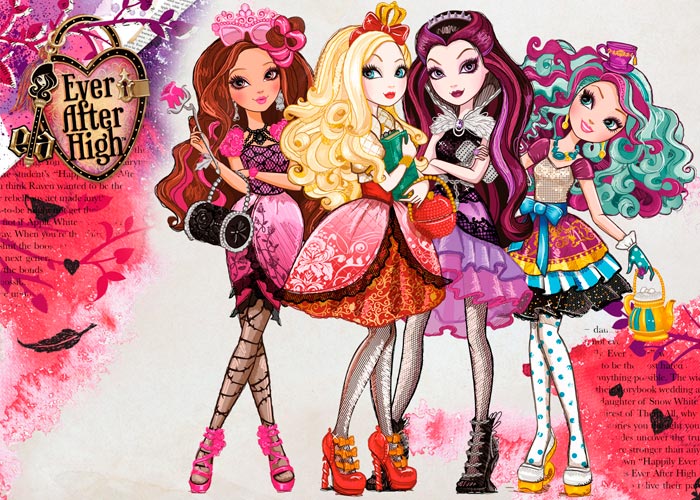
Remember the "good old days" of franchise-launched fantasy cartoons centered on toys, such as My Little Ponies, Strawberry Shortcake, Care Bears, Lady Lovely Locks, and Rainbow Brite?  (Children of the 80's, you know what I mean.)  Some are getting modern-day makeovers, but there are also some new kids on the block.  Out of curiosity, I clicked on a mini-series called Ever After High on Netflix, and it just goes to show that fairy tales will never, ever get old . . . or lose their potential for advertising!


From left to right: Briar Beauty, Apple White, Raven Queen, and Madeline (Maddie) Hatter

Ever After High is like Clueless meets Ponyville: where the children of famous fairy tale characters dress like themed lolitas and talk in insufferable puns while gushing about shoes, secret parties, and the dating scene.  It's where Hogwarts gets a run for its money with adult authority figures such as Headmaster Grimm, Baba Yaga, and Professor Rumplestiltskin.  It's also where they're expected to fulfill their pre-written destinies by following in their parents' footsteps.  Enter the main series conflict.
Ever After High: The Storybook of Legends
It's interesting to see what types of fairy tale trends take hold in this Barbie-esque multiverse.  There is the super-sugary blonde goody-goody befriending the antagonist-presented-as-protagonist misfit (Wicked); crossover characters from literary fantasies, such as Alice in Wonderland and Robin Hood (Once); and the forbidden romance between Red Riding Hood and the Big Bad Wolf (every supernatural romance ever).

Something else I found interesting was the choice to make Apple White, Snow White's daughter, a blonde.  Though this was probably a purely aesthetic choice to make her contrast the daughter of the wicked queen, Raven Queen.


Will he rescue Snow White or Red Riding Hood?

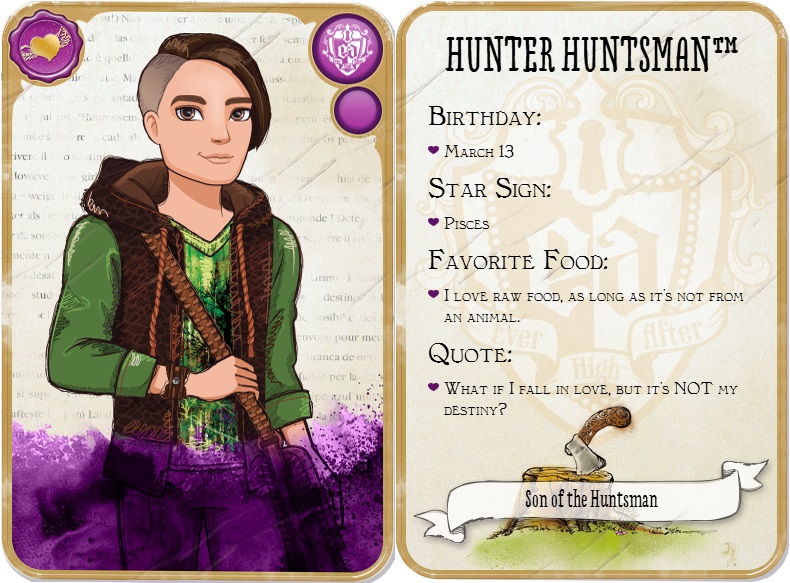
There are some clearly problematic things that naturally arise when combining fairy tales that were not addressed in the series.  Such as, in which story does Hunter Huntsman belong?  Or is the Huntsman, his father, the archetypal character that plays one role in many stories.  If the princes Daring and Dexter Charming are the sons of King Charming, aren't they also the brothers of Cinderella's daughter, Ashlyn, and even Apple, making the pre-determined pairing of Apple and Daring incestuous?  If the Evil Queen is Snow White's stepmother, then Apple and Raven should be a generation apart, and Raven effectively Apple's aunt (Raven's mother is Apple's mother's stepmother).  How far back do the generations go, exactly?  Is there a line of hundreds of Goldilocks, or just the two, Goldie Locks and her daughter Blondie?

There's nothing of really deep, lasting substance here, but Ever After High can't help but to stumble upon the roots of what haunts in fairy tales; too bad it doesn't care to water them and see how they grow.  Perhaps, the opportunity for delving is better humored in storybook format: Shannon Hale, acclaimed author of The Goose Girl, is authoring an Ever After High fiction series, with several books currently published.

Ever After High: The Storybook of Legends

fleur2

Wednesday, April 16, 2014

21st Century Fairy Tale Telling

Metalalia--Postmodern Fairy Tales for Your Tablet and Phone


It's been about 200 years since the brothers Grimm first committed pen to paper in order to preserve the folktales of their native Germany.

Since then, fairy tales have grown and contracted, been melted down and reforged to make new alloys of folk-and-fiction.  The twenty-first century has already seen impressive and stunning contributions to the fairy tale tradition, but what about the storytelling medium?  To see the written word upon paper expire is the last thing I want, as I'm sure all of you agree.  But adaptability is key to survival.  And movies just aren't cutting it as a successful fairy tale medium (see my review of Disney's latest Frozen).

Enter Metalalia, an immersive, digital fairy tale storytelling experience.

character design for The Wind-up Boy

Musician Pam Shaffer and author Alex Nicholson have defied distance to join their creative efforts over the width of the Atlantic (Steel thistles and glass mountains?  Please!).  Together, with a team of talented professionals, they've laid the foundations for an app that will bring "future-twisted fairy tales" to your fingertips with original scores, fresh imagery, and interactive elements.  This means users will be able to "tailor their experience by combining or removing artistic elements, customizing the story, and making it more accessible."

first page of The Hair-Woven Rope

A multimedia storytelling experience that harnesses organic audience-to-author interaction recreating folkloric origins in a 21st century context?  I think yes.

The Metalalia team are rallying fairy tale enthusiasts and free-spirited creative types to help them fund the launch of their app on Kickstarter.  At the time of my writing, they have already raised almost $2,000 of their $9,000 dollar goal.

If this looks like something you'd appreciate; if you feel the importance of the digital medium in preserving our sacred fairy tales and engendering new ones; or if you just want some really cool freebies, click over there and donate anything from $1 to $1,000.  Whatever you feel moved to contribute.

If you're at all like me, they'll have you at "digital illuminated manuscript" and "William Blake."

fleur2

Thursday, February 6, 2014

Missing the Heart of the Fairy Tale

A Review of Disney's Frozen


I should be sleeping, or reading Harry Potter and the Prisoner of Azkaban, but I stumbled upon this review of Frozen and remembered that I had similar things to say about it.  So.


I liked Frozen.  It was funny, sweet, and well-animated, if a bit buggish (whatever happened to the beautiful, graceful characters from original Disney, making appearances as late as Princess Tiana?).  The songs weren't particularly moving, but I did get the refrain do you want to build a snowman? stuck in my head, so I suppose it was effective.  It takes place in a clear and easy-to-pinpoint location with decent attention to the visualization of culture and customs.  Being a fan of folk culture, and especially Scandinavian folk culture, I enjoyed that part of the film immensely.  But for our purposes here on Straw into Gold, it is imperative that I communicate the residual impression it left with me, which was this: Frozen was not, except by a deft maneuvering of the imagination, a fairy tale.


Minkyu Li, Frozen concept art

My problem with Frozen is that it was virtually gutted of all things Faerie.

I don't mean that it was hardly recognizable from its inspiration, Hans Christian Anderson's The Snow Queen, although it was that.  I mean the magic was all but absent.

Oh, there was magic, as in the powers of Princess Elsa to make ice and snow from the touch of her fingertips.  But there was an utter lack of the magic of Faerie; the sense of and cautious reverence for the Otherworld; of danger from an almost-but-not-quite pernicious sentience; of the fickle, and uninterested, yet inexplicably connected existence just beyond the reach of of our own.  There was no alarm at Elsa's powers or inkling that something deeper was going on in relation to them (the curse of a slighted fairy, or the residual trait of an ancestor's mingling with gods); and even the characters' fear of Elsa was not found in the nature and source of the powers but in her potential to do damage with them.  After the ball scene when the new queen's secret is revealed, Anna doesn't even pause to wonder at this astounding development; it's all par for the course.  "So that's why she's shut me out all these years."  O-kay.

Granted, in traditional fairy tales, fantastic events are often presented without any commentary on their fantasticness.  But the fairy tales never mean to make the fantastical belong to the mortal.  There is always an explanation of sorts, even if that explanation shuts out further investigation, like the lid of box snapping shut on a hand.  "She was actually a faerie changeling in disguise."  That's it, that's all that's needed.  A recognition of the Other, of some always-and-ought-to-be unknown.

Even the trolls are pared down to their lowest common denominator, emptying them of all the mystery and danger of the otherfolk and making them mere comical, cartoonish creatures.

Finally, the glass shard in the heart* loses its potency.  Rather than darkening the sight of Anna,** the shard in the eye (generalized to "head" in the movie) only knocks her unconscious and turns white a strand of her hair.  All her memories have to be erased so she forgets her sister's gift-curse and doesn't question Elsa's separation from her.  But that is a secondary, and not a direct, result of the ice shard.  The second ice shard slowly freezes Anna's body but leaves her heart untainted.  What kind of congress with Faerie only touches the outside of a person, only his physical existence; leaves his perception of the world unshaken?

When Anna finally reaches the palace of her ice queen sister, it is opposite of what little Gerda finds when she arrives at the sheer and terrible fortress of the Snow Queen.  Anna finds only a very human girl, with very human hurts and emotions and fears, and the rest of the palace empty.  But Gerda finds the Snow Queen absent--as her nature, one might say, is a great, gaping absence--and dear Kai with his soul half-killed, working away mechanically at a puzzle made of shards of ice, trying, yet ever failing, to form the word eternity.  Anna's act of sacrificial love for her sister Elsa breaks the spell, as one would expect.  When Elsa feels and knows her sister's love for her, her frigid emotional walls falter and crumble.  It is a self-administered cure.  But when Gerda finds poor Kai enslaved to logic--the ice-cold logic of the mind, of science, of nature, and of seasons--her shed tears melt his heart and wash loose the shards of glass.

source

For Faerie is vast and fierce, and we often tremble before it and believe ourselves helpless.  But in this, the heroes and heroines of fairy tales prove us mistaken.  We are not helpess.  Faerie is wild but not immune to obeisance--for those with stout hearts and stubborn wills, though the winter seem endless, and the journey long.


*  changed from glass to ice in the movie, so as to remove the uncomfortable and politically incorrect hell-mirror-falling-from-heaven scenario
**  who is the combination of Kai and Gerda from Anderson, though Elsa, the Snow Queen figure, has bits of Kai in her as well

fleur2

Thursday, January 23, 2014

Something in the Water


Do do do do do do do do do do

I wear a demeanor made of bright pretty things
What she wears, what she wears, what she wears
Birds singing on my shoulder in harmony it seems
How they sing, how they sing, how they sing

Give me nights of solitude, red wine just a glass or two,
Reclined in a hammock on a balmy evening
I'll pretend that it's no thing that's skipping my heart when I think of you
Thinking of me babe I'm crazy over you

Aaah Aaah Aaah
There's something in the water, something in the water
Aaah Aaah Aaah
There's something in the water, that makes me love you like –

I've got halos made of summer, rhythms made of spring
What she wears, what she wears, what she wears
I got crowns of words a woven each one a song to sing
Oh I sing, oh I sing, oh I sing

Give me long days in the sun,
Preludes to the nights to come
Previews of the mornings laying in all lazy
Give me something fun to do like a life of loving you
Kiss me quick now baby I'm still crazy over you

Aaah Aaah Aaah
There's something in the water, something in the water
Aaah Aaah Aaah
There's something in the water that makes me love you like I do

Oooh oooh oooh [x3]

Give me nights of solitude, red wine just a glass or two, give me something fun to do

Aaah Aaah Aaah
There's something in the water, something in the water
Aaah Aaah Aaah
There's something in the water that makes me love you like I do

Aaah Aaah Aaah
There's something in the water, something in the water
Aaah Aaah Aaah
There's something in the water that makes me love you like I –

Do do do do do do do do do do

fleur2

Wednesday, September 4, 2013

Hansel and Gretel, All Grown Up

A Review of Hansel and Gretel: Witch Hunters


"Brothers Grimm who--?  I don't understand what I'm looking at here."

I watched Hansel and Gretel with very little expectations--perhaps that's why it managed to surprise me.

At one point during the film, I glanced down at the play bar to see that it was more than halfway done.  During many a movie, this habit of mine happens much earlier and more frequently, often followed by an anxiety for the amount of time still left to lumber by.  But Hansel and Gretel: Witch Hunters was actually quite entertaining, if not the stuff of legends.

The film narrative carries on after the trauma of Hansel and Gretel in the candy house in the woods.  Rather than return to a remorseful father and a deceased wicked (step)mother, the two children come away with the lesson that the only ones they can trust in the world are each other.  They go on to make a career out of protecting other children by hunting and slaying witches in pre-industrial Germany.  And they're pretty darn successful at it, until they come up upon a particularly difficult quarry--a grand witch, who seems to be methodically kidnapping children for a sinister plot that goes beyond mere snacking.

In the anachronistic style made popular by movies like Van Helsing and Brothers Grimm, the siblings carry modernized weapons, wear suspiciously hip-looking clothes, speak in generic American English, and basically hold with all the values and norms of twenty-first century westerners.  The film's makers, rather than try take it seriously, threw themselves into the irony of it all and made it over-the-top bloody, fast-paced, and humorously ridiculous.  

"Try to look moody."

It worked well.  Like I said, I don't think I was bored for a moment.  And while I guessed at the plot mysteries pretty easily, I commend them for keeping it neat and tidy, without trying to philosophize or leaving loose ends.

In the end, despite all the showy explosions and corny one-liners, the emotional core of the German fairy tale is intact: the reality of evil, the dangers of the wood, the resourcefulness of children, and the lesson that things are not always what they seem.

A grand fairy tale adaptation this is not.  So don't watch Hansel and Gretel: Witch Hunters if you're a purist and tend to outrage.  But it is in good fun.  And that was, after all, a big part of what fairy tales were meant for.

(For a more traditional dip into the Grimm tales, Cate at Something to Read for the Train is going systematically through the complete tales of the Brothers Grimm and reviewing them here.  I'm excited.  So go check it out!)

fleur2

Tuesday, July 16, 2013

HPP: Engaging the Critics, Part I

A few weeks ago, Masha shared a couple of links to commentaries about Harry Potter from renowned scholars, each in their own field--Harold Bloom of literary canon fame and Michael O'Brien from the classical Catholic educational background (think Tolkien and Lewis).  Both are the types (I think, in O'Brien's case) to rally behind the white Anglo-Saxon male dominated canon, and that's not necessarily a condemnation from me.  I just think it's interesting that we have two critics with similar tastes, who dislike Harry Potter for differing reasons, and worth mentioning.

Never one to shy away from stating the obvious, below I am going to examine their arguments in full, starting with Bloom.  At current writing, I do not know whether I "agree" or "disagree" with either Bloom or O'Brien.  Rather, I am writing this break-down as an examination, and we shall see where we stand when we arrive at the end.

Harold Bloom does not begin well when he likens the popularity of Harry Potter to that of Tolkien--something that is inexplicable and cheap, that will wane with time.  Then he makes the claim (as many have, I am told) that Harry Potter is not well written.

Harold Bloom and JRR Tolkien

Now, if he means that the lexicon is limited and the syntax straightforward, he is right.  It is a children's book, however, and the first of a series: it is to be expected that it will start simple to attract a young, wide audience.*  But fair enough, I'll give him that.

If he means in terms of plot, I'm not sure I follow (no pun intended).  The plot is engaging, grabbing the reader in from the first page and keeping the events fresh but relevant.  I suppose he is looking for something more cerebral, like a late Henry James?  A novel of manners, like Jane Austen?

As for the characterizations, I cannot see how they are simple or one-dimensional.  Quite the contrary.  There are layers there to Snape and Dumbledore that are communicated very well for the simpleness of the novel.

Rowling also draws from tried-and-true mythological traditions.  Perhaps Bloom is looking for something revolutionary?  But then, canon is a predictable cycle of action and reaction, each new literary movement a direct opposite from the one preceding it, so often the novelty of a novel (see the irony** there?) is overstated and over-represented by the juxtaposition, and truly "new" literary inventions are much rarer than first made out to be.  So is Bloom disapproving of Rowling's following of the (very successful) conventional literary formula?  (See * below.)  It seems this is the case, when he says that Harry Potter does not posses an "authentic imaginative vision."

I know his intentions are good, but after reading the HP essay,
it's such a presumptuous title!
source?

He writes

Rowling has taken 'Tom Brown's School Days' and re-seen it in the magical mirror of Tolkein (sic.).***  The resultant blend of a schoolboy ethos with a liberation from the constraints of reality-testing may read oddly to me, but is exactly what millions of children and their parents desire and welcome at this time.

Yes, okay.  Well . . . so?

In what follows, I may at times indicate some of the inadequacies of  "Harry Potter."  But I will keep in mind that a host are reading it who simply will not read superior fare, such as Kenneth Grahame's "The Wind in the Willows" or the "Alice" books of Lewis Carroll.  Is it better that they read Rowling than not read at all?  Will they advance from Rowling to more difficult pleasures?

Ah, now I see.  He's concerned for the youth.  c;

Rowling presents two Englands, mundane and magical, divided not by social classes, but by the distinction between the "perfectly normal" (mean and selfish) and the adherents of sorcery. The sorcerers indeed seem as middle-class as the Muggles, the name the witches and wizards give to the common sort, since those addicted to magic send their sons and daughters off to Hogwarts, a Rugby school where only witchcraft and wizardry are taught. Hogwarts is presided over by Albus Dumbeldore as Headmaster, he being Rowling's version of Tolkein's (sic.)**** Gandalf. The young future sorcerers are just like any other budding Britons, only more so, sports and food being primary preoccupations.

He's absolutely right about the two Englands, something I find delightful about Harry Potter, from the first time I picked up The Sorcerer's Stone years ago.  It's the typical set-up for a fairy tale, the mundane of everyday weighing heavily on the reader via the character; only too soon to disappear, we know, else we would probably put the book down and cease reading (or we'd have been reading Virginia Wolf to begin with).  And yes, there is a caricature of normal people as "mean and selfish," but I see parallels there to other children's authors such as Roald Dahl and Lemony Snickett.  Does the caricaturing make it unacceptable, but (and correct me if I'm wrong, really) doesn't Charles Dickins do a bit of that as well?  And is the flat-out, accurate-in-all its-ugliness depiction of human depravity in stories such as Heart of Darkness acceptable?*****

The statement about those "addicted to magic" seems inaccurate, as it is clearly shown that magic is an inherited trait and not something achieved by mere wishing.  Bloom says that the reasoning for Harry's being handed to the guardianship of his aunt and uncle is never disclosed by Rowling, but I've been told by those knowledgeable of the series that this is not the case.  So there's some inaccuracy about the books, which, if not undoing his points, certainly throws uncertainty on his credibility.  He goes on about Harry's upbringing for a while, and I gather that his issue so far has been with HP's conventionalism.  So Rowling's is a sin of unoriginality.

"A born survivor, Harry holds on until the sorcerers rescue him and send him off to Hogwarts, to enter upon the glory of his schooldays."  Point well made.

He admits the admirability of Harry in the climax [SPOILERS], then says, "Why read, if what you read will not enrich mind or spirit or personality?"

Now, as far as I have read, Harry Potter is not a challenging, game-changing story.  But I have to protest the implication that reading it will not at all enrich mind, spirit, and personality.  What is the anthropomorphic castle if not an introduction to the Gothic genre?  And the Flamels' longevity coupled with Voldemort's rabid lusting for the Stone (and the blood of innocents) if not a grammary to Paradise Lost?  On the contrary, I think Rowling's borrowing of these classic elements is essential to and accountable for, at the very least, some of the interest in Harry Potter, beyond action in the form of zipping brooms and hi-jinks with clever and uncomfortable spells.  To the meat of the story, those things are pink fluffy frosting; they give a temporary sugar-high, no doubt, that distracts from the more substantial substance (seewhatIdidthar?) of the story; but the ingredients for a good, sturdy recipe are present underneath, and they remain when the saccharine "tricks" and "spectacle" fade.  And yes, it is a recipe, in the sense that is a formula.  But we follow recipes and formulas because they work.

Finally, the zinger:

I hope that my discontent is not merely a highbrow snobbery, or a nostalgia for a more literate fantasy to beguile (shall we say) intelligent children of all ages.

So, there it is: literary fantasy beguiles.  It can't be worthwhile if it isn't true, or based in reality, or boring realism, or fantasy treated as realism (Henry James again?).  But the same doesn't stand for The Odyssey and the Arthurian romances . . . or did the people back then just not know any better, and so are excused from providing better fare for the literary canon?  Or is it only okay when it's satire, like Mark Twain?  Or when it's overwhelmingly dark like The Picture of Dorian Gray?

Is our lad Harry Potter on par with the greats, worthy to take his place alongside Shakespeare and James Joyce and The Canterbury Tales?  I don't think so, at least not at this point in the execution of my Harry Potter Project.  But I can't see how the reading of it is worthless and without merit entirely.

source

And I think "common" readers realize that.  As Chesterton would say, regarding the "awful authority of the masses," sometimes our humanity instinctively leads us to what is good and affirming.  Something unknown within us responds to truths never named: that friendship and self-sacrifice, and standing by what's right in the face of impossible pressure, is more than mere escape, but a glimpse toward that which the soul knows and misses, and not something to be swept up in the "dustbin of the ages."


*  The "stretching his legs" cliches he mentions on page 4 I happen to like, as it establishes the "this is just an ordinary story about an ordinary family" tone before jumping into the Shocking Reveal--this is more a sense of trite storytelling, as I am sure of the art and intelligence of Rowling enough to know that she could do better if she'd wanted to.  Then we wander into territory that asks, "Is using pre-established formula considered bad form for literature?"
**  I'm probably not using the correct definition of "irony" here!
***  You should see my expression as I acknowledge the glaring spelling error.  Let's hope it's a typo.
****  Still trying hard to believe it's a typo.
*****  Would Harold Bloom accuse me of peacocking by dropping my knowledge of literary canon?  Probably, but he'd be wrong about that, too.

fleur2

Monday, July 8, 2013

Late to Robin Hood, in More Ways than One

There's a Robin Hood retelling event over at Pages Unbound (thanks to Jenna of A Light Inside for hooking us up!), and I've never touched on the Sherwood legend on SSiG, so here's me getting my feet wet by jumping right in!

The blogmistresses posted some questions to start the ball rolling for discussion; there are also a round-up of links and book reviews, so if you're curious about more Robin Hood or an old devotee, click over and see what's what.

Discussion Questions  

1.  What versions of Robin Hood have you read? What retellings? 
I haven't! 
This question has made me painfully aware of my lack of knowledge in this department, which is a shame, because it is second to none in English-language folklore (except for Arthuriana, but you'd think the study of one would have led me to another). 
I have encountered nods-of-the-hat to Robin Hood in The Once and Future King and The Last Unicorn, and the Stephen Lawhead book Hood wins my instant interest by placing it in the march borders of Wales.  But his books are intimidatingly large and intricate, and while an avid book-lover, I've been known to have a short attention span. 
2.  What movie or television versions have you seen? 
Disney, of course, and the one with Kevin Cosner and Robin Hood: Men in Tights, which is probably the one from which most of my RH knowledge is drawn, even if in parody! 
3.  Do you have a favorite book or film? 
Not yet! 
4.  Who is your favorite classic character? 
As a childhood, hands down, Maid Marian.  Now, I don't know . . . the character of Father Tuck is interesting to me.  And of course the main character. 
5.  How do you feel about female Robin Hood characters? 
I think it can be a refreshing angle, and suitable way to reboot the legend for new generations.  I am, however, always was and will be a traditionalist: the closer to the oldest versions of the tales the better.  Even more reason for me to pick up Lawhead and plunge in, no doubt. 
6.  Do you like an emphasis on the romance between Robin and Maid Marian, or more emphasis on adventure? 
I tend to prefer adventure, unless it's really, really well-done romance.  I have an aversion to mushiness and stereotypical romances and love-at-first-sight with no other motivations backing it up.  They have to be good characters, too.  I just can't bring myself to care about the love affair of two characters I don't personally like, for whatever reason (note: I didn't say characters that were "good," but characters I like; the chemistry and conflict between an anti-hero and his/her love interest can make for some really fresh romance reading). 
Otherwise, adventure, in which tangible conflicts and difficulties challenging virtue and courage are what draw me in, especially if there is some element of mystery or some details left out that keep me turning the pages to find out the answers.

Okay, it appears like I'm late and the event is over, but I'm letting my questions stand.  Here is a great overview of the Robin Hood legend also posted over at Books Unbound.

What about you?  Do you consider Robin Hood a staple of English-language folklore?  What kind of fairy tale elements does it have, and how does it differ from a traditional fairy tale?


fleur2

Tuesday, March 12, 2013

The Meaning of Mirrors

A Review of Mirror, Mirror


I think it's safe to assume that those who are going to see Mirror, Mirror have by now, and the rest won't care if I spoil it with a review.


First, I amend my statement that Monica Keena is the most ideal-looking portrayal of Snow White so far in a movie.  Lilly Collins does nothing short of embody her.  Her coloring is spot on, her features wide and youthful, and the sweet innocence inhabits every limb and movement.  Even after her graduation to a spunky, active heroine, she successfully integrates these traits.

Second, what a beautiful visual experience--from the unique color pallet of the over-the-top costumes to the the wicked Queen's balcony-like bedchamber, opening up onto a pristine lake over a precipice and illumined with stars, it's a feast for the senses.  I haven't enjoyed looking at something so much since coming face to face with Boticelli in Florence.

The winter wood, rather than a grimy, tangled wild land, takes the form of an archetypal snowy forest.  The trees are bare and uniform, the snow pristine, and both are the only things within eyesight in every direction.  This gives it a sense of a depthless otherworld, without normal spatial bounds.  The constant snowfall combined with the fact that near-naked characters never appear to be cold highlights the dream-like experience.


As for the story, it is unabashedly straightforward.  Mirror, Mirror relies on the fact that the Snow White fairy tale is already well-known, and it chooses to concentrate on the details rather than the whole.  

The characterizations breathe and blossom; not that there is depth and psychology but a freedom for the actors to give unique performances.  Julia Roberts as the evil Queen is humorously neurotic, and I have already touched on the Lily Collins's excellent Snow White.

There is an extraordinary scene in which the wicked Queen goes through a mirror and emerges in another dimension. Here, the notorious talking mirror is housed in a hut suspended, swamp-like, on water--perhaps the place that houses the hag-as-witch side of the Queen?  It's a visually stunning scene, with pure pleasure in the experience of the not knowing what next to expect.


Still, there seems to be an absence of symbolism in these beautiful expressions.  The snowy wood is just a wood, despite its suggesting otherwise.  The Queen's descent to her mirror could be infused with meaning, but it's not.  The feeling of meaning is absent from the narrative.  If the creators of Mirror, Mirror believed in them, they didn't infuse those beliefs into filming.

In having these potent images devoid of suggestion, I wonder if Mirror, Mirror doesn't come close to the nature of true fairy tales; in which, it seems, there is no explanation or deeper motivation behind a witch wishing to eat a child or a prince compelled to dance in Fairyland each night.  Perhaps we, as viewers, are invited to bring our own experiences and instincts to the pure images.  

Or perhaps these things defy analysis, because they resonate within us somewhere primordial and instinctual, so old and buried, we've forgotten what they're for and why we have them.

fleur2

Thursday, January 31, 2013

Snow Apple

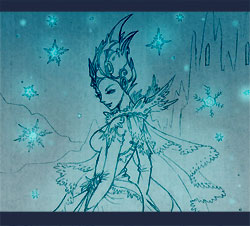
This is a superb re-telling, made to accompany a virtual item on Gaia Online.

I'm not sure of the artist and author.  Words and images were provided here.


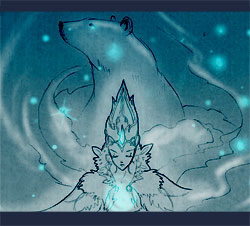
In a frozen land far from any place you have ever been, where night seemed as eternal as the cold, there reigned a queen made of ice. She was cruel and beautiful, her subjects frigid spirits, her servants souls she had taken pity upon and rescued from certain death in the cold. 

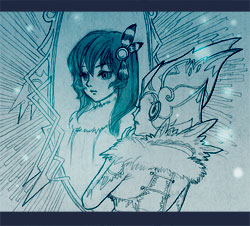
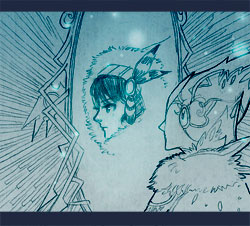
The snow queen was vain as well. She enchanted a mirror to show her the fairest woman in the kingdom, and of course, hers was always the face she would see.


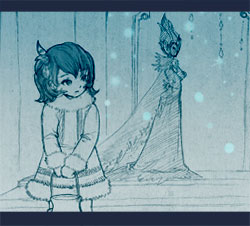
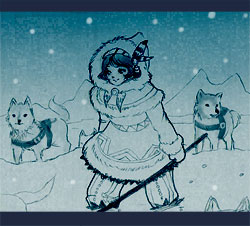
Among the queen's servants, her favorite was a child she had taken from the snow. She was quiet and hard working, and plain, the part that the queen liked most. The girl was called Snow White.


Years passed, and Snow White grew into a young woman. One day the queen asked her mirror to show her the most beautiful woman in the kingdom. . . And to her horror, the traitorous mirror did not show her own face, but the likeness of her servant.


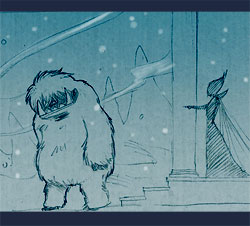
Enraged, she summoned her most powerful minion, the Yeti. She ordered him to take Snow White far out into the wilderness, and return with her frozen heart.


The Yeti obeyed and lead Snow White far across the ice, into the circle of the world that is only frozen ocean. There, he looked upon her, shivering and cold, and could not bring himself to kill her. He told her to run and hide where the queen could never find her.


Terrified, Snow White ran and ran until her lungs burned in the cold air and her legs gave out under her. Lying in the snow, she knew she would die if she didn't get up. But her eyelids felt so heavy, and the snow felt almost warm. . .


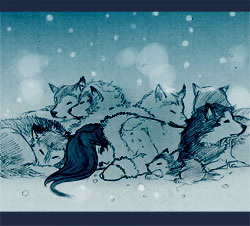
And when she opened them, she WAS warm! Piled around her were seven sled dogs, the same colors as the rocks and ice, almost as if they were born of the land.


When she asked them who they were, they replied, "We are the workers of the snow and ice. We can run forever and never fall, and despite the long cold night we will never freeze. Stay with us, young one, and we'll teach you the ways of the winter, and make you strong." She gladly agreed. Months passed. . .


And Snow White's spirit grew fierce. Even so far beyond the edges of the queen's kingdom, the enchanted mirror could see no one else. The queen knew her minion had betrayed her, and also, looking upon the face of the girl she had condemned to death. . . She felt a terrible fear.


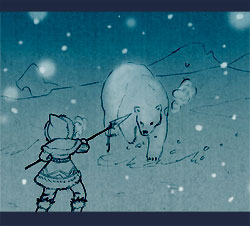
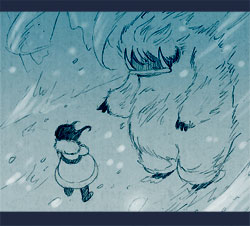
She called upon her own ferocious spirit, casting a spell to transform herself into a great white bear. She hid between her claws a sliver of ice from the very top of the world, so cold it froze anything it touched.


The queen travelled far across the ice, tracking Snow White for many weeks. Finally, they found each other in the wasteland. Snow White could not recognize the queen, and saw only a bear threatening her dogs. She lunged towards the bear even as it charged her, as fearless as she was certain that she would not emerge alive. The queen's heart trembled as she looked upon the girl, and saw her death in those dark eyes.
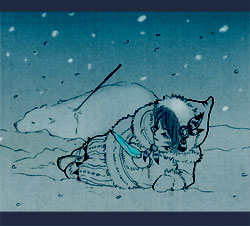
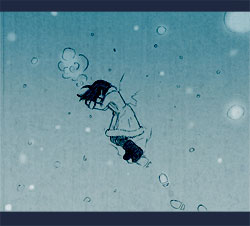
The bear faltered, its claws missing Snow White by a breath, and she saw her harpoon's opening, sealing the fate of the beast.  As she stood, she suddenly recognized the queen.  She felt a sharp pain in her chest, and looking down, she found the shard of ice, lodged in her heart.  The familiar beating of her blood stopped cold.  Even her breath froze.


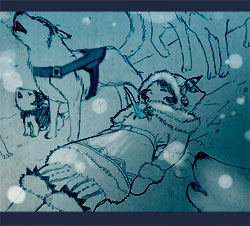
The seven dogs ran to her, but there was nothing they could do. They nipped at her boots and barked for attention, but she would not wake. Overcome with sorrow, they threw their voices to the wind, calling for help that they knew would not come.

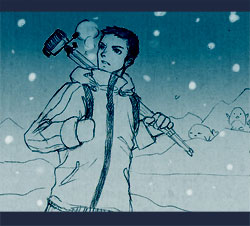
And then, a miracle happened! A survivalist named Les Cannon happened to be filming nearby, and heard the mournful howls. Adventurous and bold, he immediately determined to discover the source.


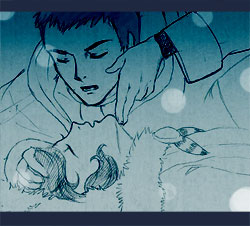
Upon arriving, he saw the frozen Snow White, and was moved. He dropped his equipment and labored to revive her. As their lips met, albeit in the breath of resuscitation and not the legendary prince's kiss, the spark thrown off from the clash of their two strong spirits melted the ice in her heart, and it leapt in her chest.


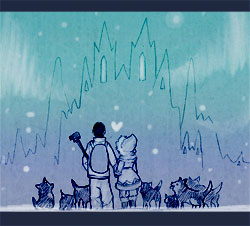
Together with the seven dogs, Snow White and Les Cannon trekked back through the winterland, intending to alert the frozen kingdom of their liberation from the queen. As the palace grew larger on the horizon, so did the faint warm blush of a long dawn. Day had come at last.

fleur2