Showing posts with label Little Red Riding Hood. Show all posts

Monday, June 19, 2017

I Want Out of the Woods

A Review of Into the Woods


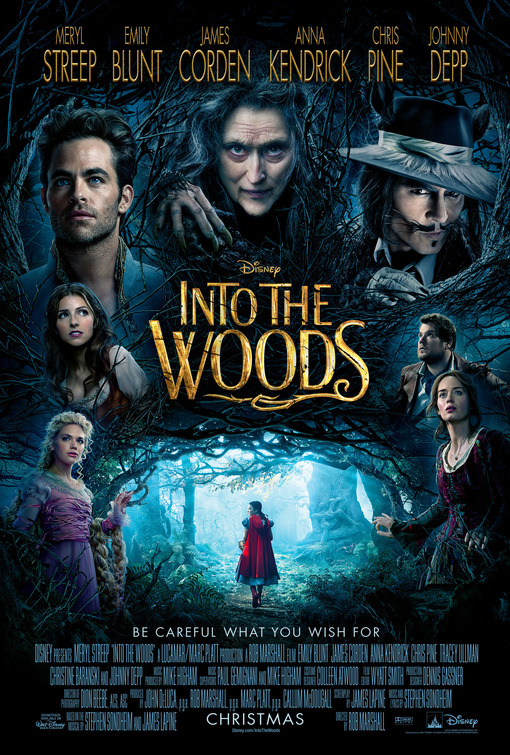
Admittedly, I know nothing of the musical Into the Woods besides a heavily edited high school performance seen well over a decade ago.  It didn't make an impression then either.  The premise of the story, an intertwining of plots and characters from several fairy tales (Grimm originals, to boot), seemed promising.  That and the the all-star cast line-up enticed me to click play while I was browsing Netflix one evening.
source

The beginning is the best part of the whole film.  It only goes downhill from there.  The way the stories wove together were, well...passable.  And that's the best I can say about it.

I liked the setup, placing the baker and his wife into the Rapunzel tale.  The expectation of things coming together, especially the opening song, had my attention.  Emily Blunt performs very well as the Baker's Wife, combining musical dialogue with humor.  I'm fond of James Corden and pleased with his casting.  Little Red Riding Hood's introduction as the glutton is cute as well.  Interesting parallels there between her and the wolf.

As the movie played on, I felt a gaping lack of attachment to the characters--other than Mr. and Mrs. Baker: infertility is a profound struggle that touches far too many.  And Emily Blunt carried that for me.  The princes bored me to tears.  Rapunzel was a nobody; Cinderella was, as the witch says, merely "nice;" and the children are downright annoying.  Is the head-slapping relationship between Jack and his mother supposed to be endearing?

source

Meryl Streep's character is meant to express moral ambiguity, I get it, but there should have been some sort of tie-in between the bakers' infertility and her kidnapping the baker's sister to be her adoptive daughter.  What we get is tiresome sung-exposition.  Insert the Willy Wonka Gene Wilder meme here:  Tell me again about the complex parent-child relationship that plays out in complex ways and is complex!!!!  The witch having never previously expressed a desire for a child and the total lack of screen time between her and her "daughter" killed the effectiveness of any would-be emotional impact.  We could have done with a little character development.
source

In the end, the characters all work together and all get their wishes.

But--this musical wants to slap it into our heads as surely as Jack's mother--you should be careful what you wish for.  After the curtains close on the traditional endings, there is still another dragging hour of  movie left; during which, in-between trying to avoid the wrath of a giantess, they all come together to be communally unsatisfied.  A theme that feels heavy-handed and forced, desperate to join the lineup of postmodernist deconstructed fairy tales.  The deaths are stupid and pointless.  The ending utterly anti-climactic.  Into the Woods tries be profound and it's just not.  Somehow, that is worse than if they'd decided to say "sod it all!" and just make something fun and ridiculous.

Wikipedia reports that the play's

basic insight ... is at heart, most fairy tales are about the loving yet embattled relationship between parents and children. Almost everything that goes wrong — which is to say, almost everything that can — arises from a failure of parental or filial duty, despite the best intentions.

Nothing that the original stories didn't already do, and do better.

What did you think of this film?  How does it compare to the musical?  Did I miss something essential that would have otherwise earmarked this a landmark production?

fleur2

Wednesday, April 23, 2014

Non-Disney Princesses II

{Read the original Non-Disney Princesses? article here.}

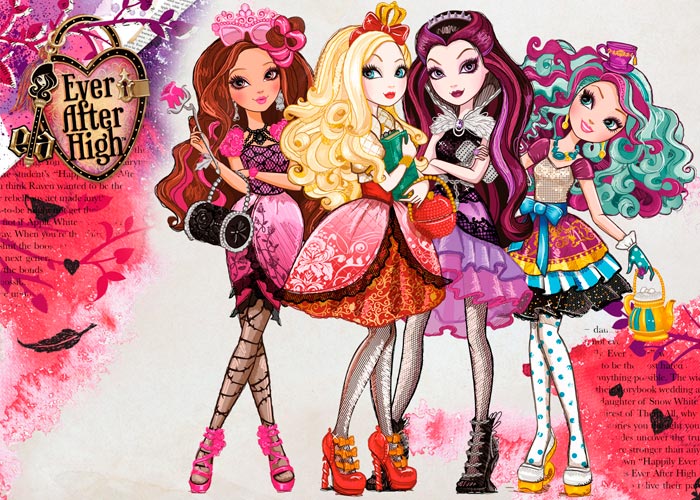
Remember the "good old days" of franchise-launched fantasy cartoons centered on toys, such as My Little Ponies, Strawberry Shortcake, Care Bears, Lady Lovely Locks, and Rainbow Brite?  (Children of the 80's, you know what I mean.)  Some are getting modern-day makeovers, but there are also some new kids on the block.  Out of curiosity, I clicked on a mini-series called Ever After High on Netflix, and it just goes to show that fairy tales will never, ever get old . . . or lose their potential for advertising!


From left to right: Briar Beauty, Apple White, Raven Queen, and Madeline (Maddie) Hatter

Ever After High is like Clueless meets Ponyville: where the children of famous fairy tale characters dress like themed lolitas and talk in insufferable puns while gushing about shoes, secret parties, and the dating scene.  It's where Hogwarts gets a run for its money with adult authority figures such as Headmaster Grimm, Baba Yaga, and Professor Rumplestiltskin.  It's also where they're expected to fulfill their pre-written destinies by following in their parents' footsteps.  Enter the main series conflict.
Ever After High: The Storybook of Legends
It's interesting to see what types of fairy tale trends take hold in this Barbie-esque multiverse.  There is the super-sugary blonde goody-goody befriending the antagonist-presented-as-protagonist misfit (Wicked); crossover characters from literary fantasies, such as Alice in Wonderland and Robin Hood (Once); and the forbidden romance between Red Riding Hood and the Big Bad Wolf (every supernatural romance ever).

Something else I found interesting was the choice to make Apple White, Snow White's daughter, a blonde.  Though this was probably a purely aesthetic choice to make her contrast the daughter of the wicked queen, Raven Queen.


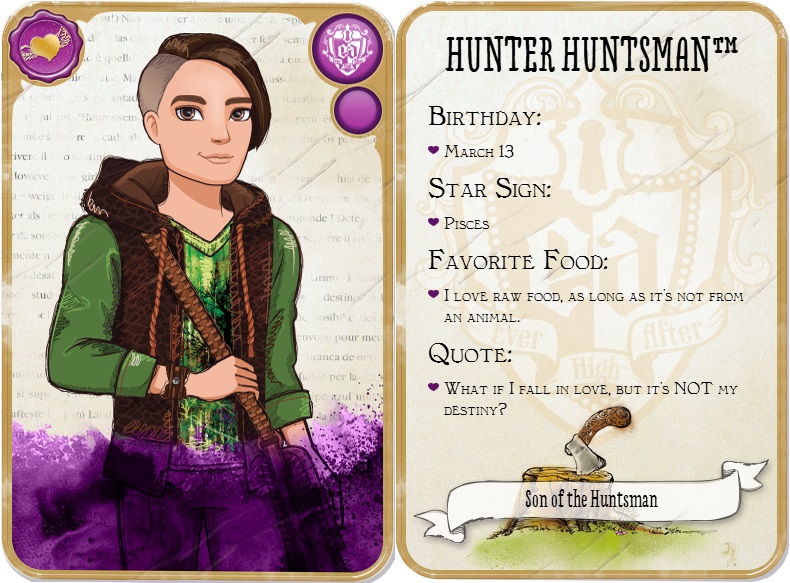
Will he rescue Snow White or Red Riding Hood?

There are some clearly problematic things that naturally arise when combining fairy tales that were not addressed in the series.  Such as, in which story does Hunter Huntsman belong?  Or is the Huntsman, his father, the archetypal character that plays one role in many stories.  If the princes Daring and Dexter Charming are the sons of King Charming, aren't they also the brothers of Cinderella's daughter, Ashlyn, and even Apple, making the pre-determined pairing of Apple and Daring incestuous?  If the Evil Queen is Snow White's stepmother, then Apple and Raven should be a generation apart, and Raven effectively Apple's aunt (Raven's mother is Apple's mother's stepmother).  How far back do the generations go, exactly?  Is there a line of hundreds of Goldilocks, or just the two, Goldie Locks and her daughter Blondie?

There's nothing of really deep, lasting substance here, but Ever After High can't help but to stumble upon the roots of what haunts in fairy tales; too bad it doesn't care to water them and see how they grow.  Perhaps, the opportunity for delving is better humored in storybook format: Shannon Hale, acclaimed author of The Goose Girl, is authoring an Ever After High fiction series, with several books currently published.

Ever After High: The Storybook of Legends

fleur2

Monday, December 17, 2012

Artist Spotlight

Emma SanCartier


We haven't spotlighted a fairy tale artist in several months, so here is some lighthearted relief via the whimsical, folksy illustrations of Emma SanCartier.

6 swans

You could put a lot of things into the category of "folksy," but when I look at her prints, I think of medieval wood stamping with a pleasant, unique mix of Maurice Sendak.

the snow queen

They are highly imaginative and superbly colorful, with luscious sweeps of the watercolor brush and veils of blues and oranges overlapping.  She also uses patterns reminiscent of native textiles.

gerda takes flight

And infuses the old tales with a little attitude.

little red riding hood
rapunzel takes action

Support Ms. SanCartier and snag some cool Christmas presents on her etsy shop.

As always, if you or someone you know is a budding fairy tale writer or artist, Spinning Straw into Gold wants to spotlight them!

fleur2

Thursday, December 6, 2012

Little Red Riding Hood and the Philosopher's Stone?

Remember this post about the significance of the colors in the art of Little Red Riding Hood?  I think this excellent article by John Patrick Pazdziora could shed more light on why colors in LRRH, and all fairy tales, create such powerful imagery.*

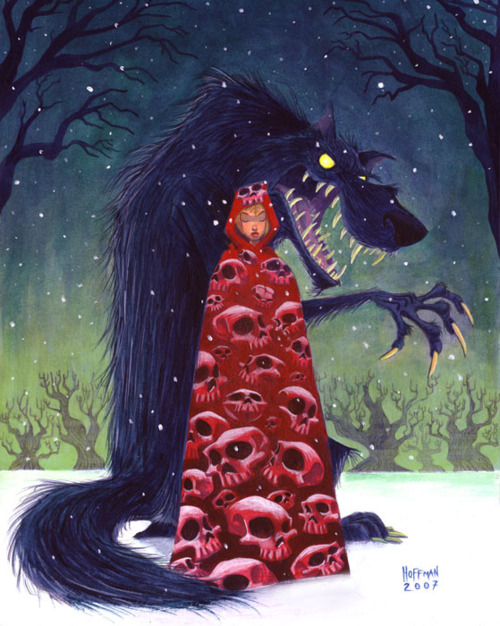
John Hoffman

Given the hypothesis that Snow White is an alchemist's tale**, what happens if we apply the same theory of colors and transformation to Little Red Riding Hood?

Thoughts, readers?  The stage is yours.


*  Also see this article dealing with a similar subject as applied to Disney's Tangled.

**  And therefore opening it up, I believe, rather than limiting it, to all sorts of significant interpretation.  There's the beginning of a thought here on the transformative power of stories that is shiver-good.  Mr. Pazdiora's concluding line that fairy tales are not meant to be questioned because they question us strikes very near my own sentiments.

fleur2

Friday, November 2, 2012

Red, Black, White

A killer cold knocked me off my feet for the past couple of weeks.  To make up for it, I've been pinning on Pinterest like a madwoman.  So check out the feed below for lots of eye-goodies.

In my subjective experience, the most popular fairy tales to be illustrated (or at least the most popular collected illustrations) are Snow White, The Little Mermaid, and Little Red Riding Hood.  And Little Red Riding Hood towers above the other two for sheer volume.  Every artist that ever posted a drawing on deviantART has tried his or her hand on LRRH.*


artist unknown, please e-mail

And no wonder.  The vampire-werewolf-insertsupernaturalhotbeinghere craze is well beyond infancy and striding confidently into hot-blooded adulthood.

But, artistically speaking, I think there is another reason why Red Riding Hood is such a popular subject for artists.  And this is something I've also noticed from my pinning.


The striking color red, and it's common-sense counterpart white, is intrinsically woven into the soul of the story.  And I'm not talking about the theory of LRRH as a cautionary tale to girls on the threshold of menstruation to beware of wolfish men.  I mean, very literally, the red hood, the black wolf and woods, and, never mentioned, but astonishingly uniform in artistic depictions, the white of the snow.

Austere, copyright konako

This is suspiciously like one of the other popular-among-artists fairy tales I mentioned, Snow White.  I don't think it's coincidence, even if it's not conscious on the part of the artist, that when painting the colors on LRRH, they pick them up from Snow White's color palette.

At the very least, it shows how powerful colors are; how one color strategically placed in a tale can color its whole flavor.  

copyright papernoodle of Etsy

What do you think?  Why are the colors red, white, and black so universal and striking?  Is it something basic in our nature, like an evolved fancy?  Or is it symbol-recognition?  Or even just human beings reacting to things that look pretty?

Can you think of any other fairy tales in which a color or colors play a significant or intrinsic role in the story?


* It's also super popular for crafts, more so than any other fairy tale I've seen so far: hoods, dolls, necklaces, puppets, folksy wood paintings . . . I don't think it's insignificant that the colors lend themselves well to traditional-type crafts.

fleur2

Sunday, October 21, 2012

Tuesday, May 1, 2012

Fairy Tales Re-envisioned


Happy May Day!

Artist and photographer Viona Ielegems (not sure if that's her last name, as it is not capitalized on the website) casts a haunting, baroque gauze to these traditional fairy tales.

Little Red Riding Hood

Snow White


Sleeping Beauty


And some new ones.

Fallen for the Unicorn

She makes costumes and runs events.  See her website for more muse-inspiring pictures.

fleur2