Showing posts with label Chesterton. Show all posts

Tuesday, April 8, 2014

The Kingdom of Arthur


I'm sorry I've been neglectful of this blog for the past year or so.  My personal life has undergone some huge shifts in the past months, one of which has been to temporarily relocate to Wales--the country adjacent to England, part of the island of Britain.

Wales is my heart's home and, as you fairy tale lovers might know, the mother of the great English-speaking tradition.  It sounds paradoxical; but most scholars agree that the culture, language, and people of Wales are the most direct inheritors of pre-Roman Britain.  It is unfortunate that the pre-Christian mythology did not survive intact like it did in Ireland, but the little that does remain is wealthy enough.  The most influential being none other than King Arthur.

So why else should people who care about fairy tales care about Wales?  The great historical scholar, Geoffrey Ashe, wrote a comprehensive volume converging British history and myth, Mythology of the British Isles, modeled on Robert Graves's book on Greek mythology.  This divides the myths chronologically and by themes, with a summary of each myth and then a historical analysis.  What emerges from these collected mini-volumes is a trail of bread crumbs leading back to Wales--which would have been to where the Brythonic peoples retreated during both the Roman and Anglo-Saxon invasions.  What is more, there was a great deal of Irish settlement in Wales from the West, cross-pollinating the mythologies and restoring and/or preserving the mythic elements shared in common between the two Celtic peoples.*

Following Chesterton's lead that all folk stories are growths from roots of fact and seeds of history, Ashe speculates that King Arthur really lived.  And out here, near the gray Irish sea-waves crashing on gray rocks and mysterious doors-in-walls, it's not a bit hard to believe.


* Though a Celtic identity was popular in the early 20th century, scholars are now in doubt as to whether or not the Celtic language-speaking peoples could justifiably be considered part of the same ethnic and cultural groups.  It is doubtful whether those who lived in Britain before Roman rule even shared genetic link with the people known as Celts to the Roman Empire of the time, or if there was merely similarity from trade and cross-cultural influence.

fleur2

Tuesday, July 16, 2013

HPP: Engaging the Critics, Part I

A few weeks ago, Masha shared a couple of links to commentaries about Harry Potter from renowned scholars, each in their own field--Harold Bloom of literary canon fame and Michael O'Brien from the classical Catholic educational background (think Tolkien and Lewis).  Both are the types (I think, in O'Brien's case) to rally behind the white Anglo-Saxon male dominated canon, and that's not necessarily a condemnation from me.  I just think it's interesting that we have two critics with similar tastes, who dislike Harry Potter for differing reasons, and worth mentioning.

Never one to shy away from stating the obvious, below I am going to examine their arguments in full, starting with Bloom.  At current writing, I do not know whether I "agree" or "disagree" with either Bloom or O'Brien.  Rather, I am writing this break-down as an examination, and we shall see where we stand when we arrive at the end.

Harold Bloom does not begin well when he likens the popularity of Harry Potter to that of Tolkien--something that is inexplicable and cheap, that will wane with time.  Then he makes the claim (as many have, I am told) that Harry Potter is not well written.

Harold Bloom and JRR Tolkien

Now, if he means that the lexicon is limited and the syntax straightforward, he is right.  It is a children's book, however, and the first of a series: it is to be expected that it will start simple to attract a young, wide audience.*  But fair enough, I'll give him that.

If he means in terms of plot, I'm not sure I follow (no pun intended).  The plot is engaging, grabbing the reader in from the first page and keeping the events fresh but relevant.  I suppose he is looking for something more cerebral, like a late Henry James?  A novel of manners, like Jane Austen?

As for the characterizations, I cannot see how they are simple or one-dimensional.  Quite the contrary.  There are layers there to Snape and Dumbledore that are communicated very well for the simpleness of the novel.

Rowling also draws from tried-and-true mythological traditions.  Perhaps Bloom is looking for something revolutionary?  But then, canon is a predictable cycle of action and reaction, each new literary movement a direct opposite from the one preceding it, so often the novelty of a novel (see the irony** there?) is overstated and over-represented by the juxtaposition, and truly "new" literary inventions are much rarer than first made out to be.  So is Bloom disapproving of Rowling's following of the (very successful) conventional literary formula?  (See * below.)  It seems this is the case, when he says that Harry Potter does not posses an "authentic imaginative vision."

I know his intentions are good, but after reading the HP essay,
it's such a presumptuous title!
source?

He writes

Rowling has taken 'Tom Brown's School Days' and re-seen it in the magical mirror of Tolkein (sic.).***  The resultant blend of a schoolboy ethos with a liberation from the constraints of reality-testing may read oddly to me, but is exactly what millions of children and their parents desire and welcome at this time.

Yes, okay.  Well . . . so?

In what follows, I may at times indicate some of the inadequacies of  "Harry Potter."  But I will keep in mind that a host are reading it who simply will not read superior fare, such as Kenneth Grahame's "The Wind in the Willows" or the "Alice" books of Lewis Carroll.  Is it better that they read Rowling than not read at all?  Will they advance from Rowling to more difficult pleasures?

Ah, now I see.  He's concerned for the youth.  c;

Rowling presents two Englands, mundane and magical, divided not by social classes, but by the distinction between the "perfectly normal" (mean and selfish) and the adherents of sorcery. The sorcerers indeed seem as middle-class as the Muggles, the name the witches and wizards give to the common sort, since those addicted to magic send their sons and daughters off to Hogwarts, a Rugby school where only witchcraft and wizardry are taught. Hogwarts is presided over by Albus Dumbeldore as Headmaster, he being Rowling's version of Tolkein's (sic.)**** Gandalf. The young future sorcerers are just like any other budding Britons, only more so, sports and food being primary preoccupations.

He's absolutely right about the two Englands, something I find delightful about Harry Potter, from the first time I picked up The Sorcerer's Stone years ago.  It's the typical set-up for a fairy tale, the mundane of everyday weighing heavily on the reader via the character; only too soon to disappear, we know, else we would probably put the book down and cease reading (or we'd have been reading Virginia Wolf to begin with).  And yes, there is a caricature of normal people as "mean and selfish," but I see parallels there to other children's authors such as Roald Dahl and Lemony Snickett.  Does the caricaturing make it unacceptable, but (and correct me if I'm wrong, really) doesn't Charles Dickins do a bit of that as well?  And is the flat-out, accurate-in-all its-ugliness depiction of human depravity in stories such as Heart of Darkness acceptable?*****

The statement about those "addicted to magic" seems inaccurate, as it is clearly shown that magic is an inherited trait and not something achieved by mere wishing.  Bloom says that the reasoning for Harry's being handed to the guardianship of his aunt and uncle is never disclosed by Rowling, but I've been told by those knowledgeable of the series that this is not the case.  So there's some inaccuracy about the books, which, if not undoing his points, certainly throws uncertainty on his credibility.  He goes on about Harry's upbringing for a while, and I gather that his issue so far has been with HP's conventionalism.  So Rowling's is a sin of unoriginality.

"A born survivor, Harry holds on until the sorcerers rescue him and send him off to Hogwarts, to enter upon the glory of his schooldays."  Point well made.

He admits the admirability of Harry in the climax [SPOILERS], then says, "Why read, if what you read will not enrich mind or spirit or personality?"

Now, as far as I have read, Harry Potter is not a challenging, game-changing story.  But I have to protest the implication that reading it will not at all enrich mind, spirit, and personality.  What is the anthropomorphic castle if not an introduction to the Gothic genre?  And the Flamels' longevity coupled with Voldemort's rabid lusting for the Stone (and the blood of innocents) if not a grammary to Paradise Lost?  On the contrary, I think Rowling's borrowing of these classic elements is essential to and accountable for, at the very least, some of the interest in Harry Potter, beyond action in the form of zipping brooms and hi-jinks with clever and uncomfortable spells.  To the meat of the story, those things are pink fluffy frosting; they give a temporary sugar-high, no doubt, that distracts from the more substantial substance (seewhatIdidthar?) of the story; but the ingredients for a good, sturdy recipe are present underneath, and they remain when the saccharine "tricks" and "spectacle" fade.  And yes, it is a recipe, in the sense that is a formula.  But we follow recipes and formulas because they work.

Finally, the zinger:

I hope that my discontent is not merely a highbrow snobbery, or a nostalgia for a more literate fantasy to beguile (shall we say) intelligent children of all ages.

So, there it is: literary fantasy beguiles.  It can't be worthwhile if it isn't true, or based in reality, or boring realism, or fantasy treated as realism (Henry James again?).  But the same doesn't stand for The Odyssey and the Arthurian romances . . . or did the people back then just not know any better, and so are excused from providing better fare for the literary canon?  Or is it only okay when it's satire, like Mark Twain?  Or when it's overwhelmingly dark like The Picture of Dorian Gray?

Is our lad Harry Potter on par with the greats, worthy to take his place alongside Shakespeare and James Joyce and The Canterbury Tales?  I don't think so, at least not at this point in the execution of my Harry Potter Project.  But I can't see how the reading of it is worthless and without merit entirely.

source

And I think "common" readers realize that.  As Chesterton would say, regarding the "awful authority of the masses," sometimes our humanity instinctively leads us to what is good and affirming.  Something unknown within us responds to truths never named: that friendship and self-sacrifice, and standing by what's right in the face of impossible pressure, is more than mere escape, but a glimpse toward that which the soul knows and misses, and not something to be swept up in the "dustbin of the ages."


*  The "stretching his legs" cliches he mentions on page 4 I happen to like, as it establishes the "this is just an ordinary story about an ordinary family" tone before jumping into the Shocking Reveal--this is more a sense of trite storytelling, as I am sure of the art and intelligence of Rowling enough to know that she could do better if she'd wanted to.  Then we wander into territory that asks, "Is using pre-established formula considered bad form for literature?"
**  I'm probably not using the correct definition of "irony" here!
***  You should see my expression as I acknowledge the glaring spelling error.  Let's hope it's a typo.
****  Still trying hard to believe it's a typo.
*****  Would Harold Bloom accuse me of peacocking by dropping my knowledge of literary canon?  Probably, but he'd be wrong about that, too.

fleur2

Tuesday, April 9, 2013

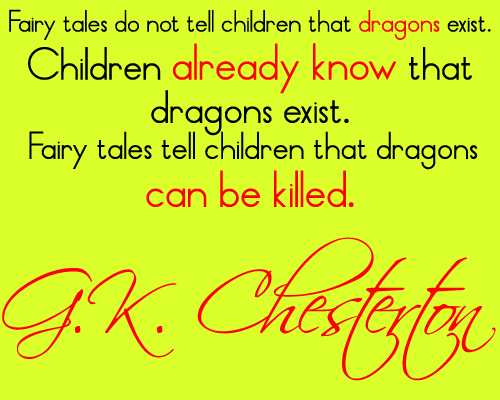
Dragons Exist

I step away from the blog for a mere three weeks and the background has disappeared!  It must be the internet elves up to no good again.


Writing is taking over my life momentarily, so now would be the perfect time to publish a guest post on Spinning Straw into Gold.  You may advertise your blog, publication, art, or anything else you like provided it has some connection to fairy tales and mythic art and provided that your post is not exclusively about the advertisement.

E-mail me at GreenInkling@gmail.com or leave a comment for more info or questions.  And bear with me while I sort out this background issue.

fleur2

Friday, February 22, 2013

The Desire for Dragons

This post is a response to the Moveable Feast hosted by Terri Windling's Myth & Moor, and other contributors to the discussion can be found here.


Jessie Wilcox Smith, The Bed-time Book

J.R.R. Tolkien wrote, in words that have initiated those they have touched into a cult of wonder ever since,

I desired dragons with a profound desire.  Of course, I in my timid body did not wish to have them in the neighborhood.  But the world that contained even the imagination of Fafnir was richer and more beautiful, at whatever the cost of peril.

Ms. Windling goes on to write,

I chose this title because Tolkien's passionate desire for a world colored by myth and mystery is one familiar to all of us who create and love mythic arts.  [. . .]  What we're discussing here is the why.  Why are we drawn to stories and other art forms (both contemporary and historic) with their roots dug deep into the soil of myth?  [emphasis mine]

It's a good question, but one which an anthropologist is likely to muddle.  As is said in the charming, post-Confederacy version of Homer's OdysseyO Brother, Where Art Thou?, "It's a fool what looks for logic in the chambers of the human heart."

But there is a logic in the longing for Faerie.  It's a different kind of logic.  The kind, G.K. Chesterton notes, that makes us instantly satisfied with the laws therein: don't go into the back room at midnight; always carry bread crumbs in your pocket; don't look a white stag in the eye; knock three times, no more, no less; if you take something back with you, be prepared to face the consequences; and never eat the food.

The anthropologist could say that our interest in wonder, in the unknown, in the unexplainable, arose as a survival mechanism to warn children of danger; or as a political move to keep tribal and religious leaders in power and to discourage questioning; it might have been a way of explaining the miracles of science at a time when people knew little about the workings of the world; maybe it was a way of comforting people and helping them deal with psychological hardships, a beautiful lie.

Why then do we still long for wonder, desire dragons "with a profound desire"?  If we have outgrown these primordial needs and they no longer serve a function; or if we are at least too sophisticated to fall into them, why do they linger?  As artifacts?  Is the desire nothing more than a vestigial organ?

skian-winterfyre of deviantART, Night Drake

Supposing it is a kind of organ.  The presence of such a thing suggests that it was once a need, and the above mechanisms of practicality do not sufficiently and satisfactorily explain it away.  For we have found other means of meeting those needs that don't require myth and fantasy.  Just look at nihilism.

So the need, or desire, is built in--not in some, as we might suspect by our tight-knit community, but in everyone.  Especially children.

As we grow older, we are discouraged from playing make believe, are told to prepare for the "real world," and forced to adapt by relegating wonder to the nursery, or, as is the case for many, to a private hobby (thanks, Richard Dawkins).  Those that don't appear to long for fantastical wonder find wonder in other ways: such as the baby-crazy teenager who ogles pictures of newborns; the devout widow who wears a veil at daily mass; the father and son who love to take apart machines and see how they work, or, if not quite so involved, at least marvel at their functioning.  This attraction to wonder is intrinsic.

If we occur, un-tampered, with a need for wonder, it logically follows that wonder is something we need to be complete.  We need it the way we need lunch, the way plants need sunshine, the way humans digest food and plants photosynthesize light.  We transform those things into our very substance.  They become an inseparable part of us.

Where is this wonder?  Why were we built without it, but wanting it, the way a plant needs photosynthesis but doesn't contain the means to photosynthesize within itself?

Such questions could easily dissolve into a tangle of religious and philosophical sophistries, but let us at least admit this: we were made for something other.  So much is that absence woven into the fiber of our being, that we know the other the minute we touch it.  It is what Edward Gardner so aptly called "familiar otherness."  Like setting foot in a real place we've only ever seen before in a dream.

Charles Santoso, source

So.  My answer to the question "why do we desire dragons?" is simple: because dragons were made for us.

This is the poverty of a society devoid of wonder, of the materialist world of men and women who say "this is all there is."  They are starving themselves, as a flower starves for sunshine.  Count yourself truly blessed, dear reader.  You are one of the few at the feast.

fleur2

Tuesday, January 29, 2013

Mercy Killing

I have a two-year-old.  We were watching the Baby First television channel together this morning at my parents and, not for the first time, we saw Baby First Tales, a series in which "9 classic fairy tales are retold and reinterpreted just for little ones."

This morning, it was Hansel and Gretel.  Here's Rumpelstiltskin.


I don't have any feeling either way with the series's sanitizing fairy tales to make them "appropriate" for the youngest of "readers."  We've been doing that for centuries now, ever since fairy tales started to appear in print.  It's the decision of a discerning parent if he or she wants to expose little ones to the sometimes scary realities of fairy tales--because in truth, that's what fairy tales do.  Expose us to realities (good and bad, the depraved and the beautiful) that we aren't mature enough to understand, or may never really understand.

But these stories have so very little in common with the eerie and sublime fairy tales from which they take their names.  Why bother calling them retellings at all?  Why not make the final jump and change the name of the characters?  It's not like a candy-made house or a difficult to pronounce name, in and of themselves, are an intrinsic part of fairy tales.

And that's just it.  I'm not offended that my beloved fairy tales have been altered beyond recognition.  I just don't consider them fairy tales.

As for my son, I continue to read fairy tales to him, in children's books that loyally translate the Grimm's versions into easy-to-digest prose, with pictures.  Straight from my collection of Hans Christian Anderson.  And from my own memory.

Obata Takeshi
(Do click on the picture to enlarge it; it's extraordinary.--C)

It is important to me that he is told fairy tales.  Not a neat lesson wrapped up in a fairy tale package, but the real, true, uneasy experience.  I'm not going to shelter him in this sense, and I don't think I need to.

The uneasiness seems to come to older children or adults who have not been read Grimms, Perrault, or Anderson, when they first hear about them.  Or to adults who sit down to analyze their favorite childhood fairy tales for the first time.

Young children who are exposed to fairy tales for the sake of hearing fairy tales, on the other hand, handle them pretty well.  Witch cannibal in an oven?  Natural.  Queen forced to dance in hot iron shoes?  What else would you do with a sociopath stepmother?  Let her plead insanity and sentence outpatient services?

Chesteron, as usual, sums up my entire feeling on this in one phrase:  "Children are innocent and love justice.  Adults are wicked and prefer mercy."

fleur2

Thursday, October 4, 2012

Disenchanted: the Fairies Return to Post-War England

Maria Tatar's introduction preps the pallet for the fairy tales that follow in Peter Davies's The Fairies Return: Or, New Tales for Old, a 1930's book republished for Jack Zipes's Oddly Modern Fairy Tales series.

The settings [of the Anglicized tales from Europe and the Orient] are Devonshire, Scotland, Ireland, and London--anything but the native soil from which some of the tales sprang.  As importantly, the untroubled appropriation of stories from the world over suggests that the tales have truly become British, that they have migrated with ease into a new culture and medium, making themselves available for literary adaptation and refashioning, once they have established themselves as part of a native storytelling tradition.

InstaCam_2012-08-18_11-16-59-PM
Though it is certainly not the only ingredient, the Englishness of these re-told fairy tales is the first and strongest to catch the attention.

"Jack the Giant Killer," by A.E. Coppard reads like newspaper headlines overheard as gossip on the street.  When three giants arrive in London from nowhere-in-particular, the citizens spend a lot of time talking about doing something and never doing it.  Enter Jack, a young fisherman from Cornwall.

Jack shows up at the Boss's house.  Love-at-first-sight follows with the Boss's daughter, 

. . . a fine piece, as plump as a leveret, and her name was Primrose.  She sat down beside their grandfather's clock and looked at Jack.  The more she looked the more she liked.  She grew quite fond of him.  His hair was red and his figure was good.  He liked her and the look of her.

He told the Boss he would undertake the extermination of the giants.  'Pray do,' said the Boss.  'I myself will privately double the reward. . . .'

'Never mind the reward,' Jack answered.

'What!' cried this Primrose.  'It is twenty thousand pounds now, and you are but a poor fisher lad!'

'I know,' said he; 'and of course I wouldn't mind it, in a manner of speaking, and I wouldn't refuse it, but I'd do it just the same for love--if you understand me rightly.'

The beauteous Primrose went up to him and put her two milk-white hands on his shoulder.  'I do,' she murmered.  'You are the dream of my life.'

[. . .]

'Shall I see you again?' [Jack] asked Primrose.

'Any time you like,' answered the princess--for such she undboutedly was.

It is all very practical and un-romanticized.  If it weren't for the obviously tongue-in-cheek tone, I might mistake it for a forerunner to magical realism.

copyright Michaela Knížová

In contrast to the bread-and-butter plainness of the 20th century English "peasantry," we have the depiction of the more elegant, much more ridiculous aristocracy in Lord Dunsany's "Little Snow-White," "With reverent apologies to the memory of Grimm:"

It will of course be remembered that Lord and Lady Clink, after the second marriage of the former, did a good deal of entertaining at their house in Grosvenor Square.  Ostensibly the innumerable parties were to amuse Blanche, the daughter of Lord Clink by his first marriage; but, as she was often in bed before they started, there were those who attributed the lavish entertainment to a certain frivolity in Lady Clink, or a merely perverse intention to flout those taxes that are so much a feature of our country.  Of these entertainments it is scarcely necessary to remind the reader, culminating as they did in the festivities on the occasion of the coming out of Blanche Clink, an event scarcely likely to be forgotten, either on account of the magnificence of Lady Clink's hospitality or because the unusual circumstance that Blanche came out at the age of seven.  [emphasis mine]

Instead of a magic mirror, the queen-figure has a gramophone which "speaks" to her.  It is the best money can buy.  

I am reminded of Chesterton's swift condemnation:  "The gramophone is a central mechanism giving out to men exactly what their masters think they should have."  There is biting irony in Lord Dunsany's use of this new invention as the wicked magical medium of Snow White's evil stepmother.

Instead of a huntsman, there is a chauffeur.  Instead of dwarfs, there are seven miners--not entirely new in itself but relevant enough to the scene.  Instead of a prince, there is the son of an entrepreneurial businessman named Mooch.

Dunsany's dismissal of wonder is easily summed up in the sentences, "And one of these bumps shook the bit of apple out of Blanche's mouth, the bit where it joins the stalk, where the arsenic solution had gathered.  And the effect of this, as anyone who understands poisons will tell you, was to bring Blanche alive again."

Ms. Tatar notes that, "Satire, with its historical specificity and commitment to topical issues, does not inhabit a 'once upon a time' but the 'here and now.'"

Both satire and fairy tale are driven by lack, by a sense that something vital is missing and that social circumstance shave made life short, nasty, and brutish. . . .  If satire is missing the rainbow promise of "happily ever after" found in fairy tales, it contains the Enlightenment promise that reason and wit will lead to steady improvements.

InstaCam_2012-10-04_10-42-49-AM

In the wake of the Great War, in the deep bowl of economic depression, on the doorstep of World War II, these stories are the cultural tradition of a disillusioned generation.  These are not fairy tales in the tradition sense.  As I read on, I don't believe they will offer an inkling of things-working-behind-the-scenes that seem to pull the strings behind the old folklore.

Still, they are skilfully and delightfully executed renderings, a treasure-collection of the talents of the time, and plain good literature.  I recommend them without hesitation.


fleur2

Monday, June 11, 2012

One Foot in Fairyland

G.K. Chesterton, the patron saint of our blog, in his most popular work, Orthodoxy (emphasis mine):
The ordinary man has always been sane because the ordinary man has always been a mystic.  He has permitted the twilight.  He has always had one foot on earth and the other in fairyland.  He has always left himself free to doubt his gods, but unlike the agnostic of today, free also to believe in them.  He's always cared more for truths than for consistency.  If he saw two truths that seemed to contradict each other, he would take the two truths and the contradiction along with them. . .  Thus he has always believed that there was such a thing as fate but such a thing as free will also.
This says something heart-achingly profound about fairy tales, and why they matter.
fleur2