Showing posts with label Cinderella. Show all posts

Monday, June 19, 2017

I Want Out of the Woods

A Review of Into the Woods


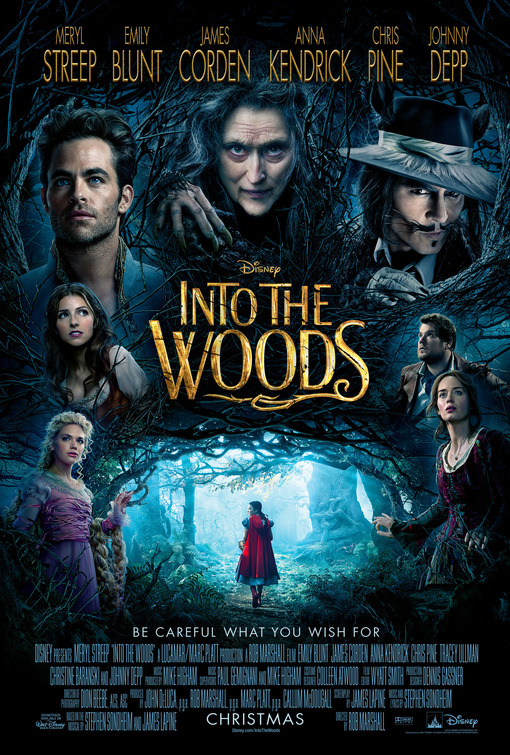
Admittedly, I know nothing of the musical Into the Woods besides a heavily edited high school performance seen well over a decade ago.  It didn't make an impression then either.  The premise of the story, an intertwining of plots and characters from several fairy tales (Grimm originals, to boot), seemed promising.  That and the the all-star cast line-up enticed me to click play while I was browsing Netflix one evening.
source

The beginning is the best part of the whole film.  It only goes downhill from there.  The way the stories wove together were, well...passable.  And that's the best I can say about it.

I liked the setup, placing the baker and his wife into the Rapunzel tale.  The expectation of things coming together, especially the opening song, had my attention.  Emily Blunt performs very well as the Baker's Wife, combining musical dialogue with humor.  I'm fond of James Corden and pleased with his casting.  Little Red Riding Hood's introduction as the glutton is cute as well.  Interesting parallels there between her and the wolf.

As the movie played on, I felt a gaping lack of attachment to the characters--other than Mr. and Mrs. Baker: infertility is a profound struggle that touches far too many.  And Emily Blunt carried that for me.  The princes bored me to tears.  Rapunzel was a nobody; Cinderella was, as the witch says, merely "nice;" and the children are downright annoying.  Is the head-slapping relationship between Jack and his mother supposed to be endearing?

source

Meryl Streep's character is meant to express moral ambiguity, I get it, but there should have been some sort of tie-in between the bakers' infertility and her kidnapping the baker's sister to be her adoptive daughter.  What we get is tiresome sung-exposition.  Insert the Willy Wonka Gene Wilder meme here:  Tell me again about the complex parent-child relationship that plays out in complex ways and is complex!!!!  The witch having never previously expressed a desire for a child and the total lack of screen time between her and her "daughter" killed the effectiveness of any would-be emotional impact.  We could have done with a little character development.
source

In the end, the characters all work together and all get their wishes.

But--this musical wants to slap it into our heads as surely as Jack's mother--you should be careful what you wish for.  After the curtains close on the traditional endings, there is still another dragging hour of  movie left; during which, in-between trying to avoid the wrath of a giantess, they all come together to be communally unsatisfied.  A theme that feels heavy-handed and forced, desperate to join the lineup of postmodernist deconstructed fairy tales.  The deaths are stupid and pointless.  The ending utterly anti-climactic.  Into the Woods tries be profound and it's just not.  Somehow, that is worse than if they'd decided to say "sod it all!" and just make something fun and ridiculous.

Wikipedia reports that the play's

basic insight ... is at heart, most fairy tales are about the loving yet embattled relationship between parents and children. Almost everything that goes wrong — which is to say, almost everything that can — arises from a failure of parental or filial duty, despite the best intentions.

Nothing that the original stories didn't already do, and do better.

What did you think of this film?  How does it compare to the musical?  Did I miss something essential that would have otherwise earmarked this a landmark production?

fleur2

Wednesday, March 25, 2015

Wednesday, April 23, 2014

Non-Disney Princesses II

{Read the original Non-Disney Princesses? article here.}

Remember the "good old days" of franchise-launched fantasy cartoons centered on toys, such as My Little Ponies, Strawberry Shortcake, Care Bears, Lady Lovely Locks, and Rainbow Brite?  (Children of the 80's, you know what I mean.)  Some are getting modern-day makeovers, but there are also some new kids on the block.  Out of curiosity, I clicked on a mini-series called Ever After High on Netflix, and it just goes to show that fairy tales will never, ever get old . . . or lose their potential for advertising!


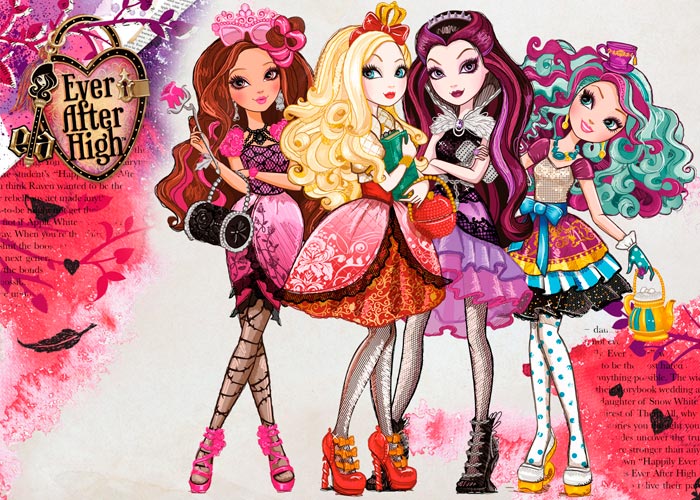
From left to right: Briar Beauty, Apple White, Raven Queen, and Madeline (Maddie) Hatter

Ever After High is like Clueless meets Ponyville: where the children of famous fairy tale characters dress like themed lolitas and talk in insufferable puns while gushing about shoes, secret parties, and the dating scene.  It's where Hogwarts gets a run for its money with adult authority figures such as Headmaster Grimm, Baba Yaga, and Professor Rumplestiltskin.  It's also where they're expected to fulfill their pre-written destinies by following in their parents' footsteps.  Enter the main series conflict.
Ever After High: The Storybook of Legends
It's interesting to see what types of fairy tale trends take hold in this Barbie-esque multiverse.  There is the super-sugary blonde goody-goody befriending the antagonist-presented-as-protagonist misfit (Wicked); crossover characters from literary fantasies, such as Alice in Wonderland and Robin Hood (Once); and the forbidden romance between Red Riding Hood and the Big Bad Wolf (every supernatural romance ever).

Something else I found interesting was the choice to make Apple White, Snow White's daughter, a blonde.  Though this was probably a purely aesthetic choice to make her contrast the daughter of the wicked queen, Raven Queen.


Will he rescue Snow White or Red Riding Hood?

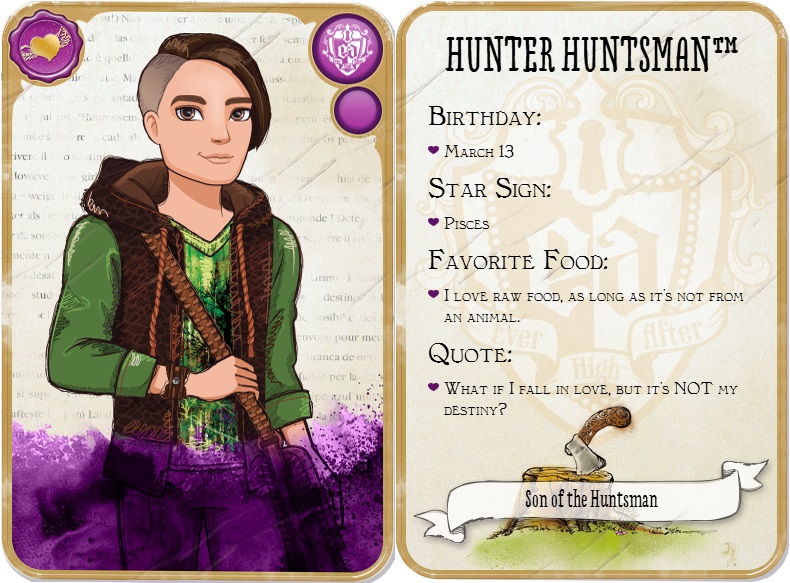
There are some clearly problematic things that naturally arise when combining fairy tales that were not addressed in the series.  Such as, in which story does Hunter Huntsman belong?  Or is the Huntsman, his father, the archetypal character that plays one role in many stories.  If the princes Daring and Dexter Charming are the sons of King Charming, aren't they also the brothers of Cinderella's daughter, Ashlyn, and even Apple, making the pre-determined pairing of Apple and Daring incestuous?  If the Evil Queen is Snow White's stepmother, then Apple and Raven should be a generation apart, and Raven effectively Apple's aunt (Raven's mother is Apple's mother's stepmother).  How far back do the generations go, exactly?  Is there a line of hundreds of Goldilocks, or just the two, Goldie Locks and her daughter Blondie?

There's nothing of really deep, lasting substance here, but Ever After High can't help but to stumble upon the roots of what haunts in fairy tales; too bad it doesn't care to water them and see how they grow.  Perhaps, the opportunity for delving is better humored in storybook format: Shannon Hale, acclaimed author of The Goose Girl, is authoring an Ever After High fiction series, with several books currently published.

Ever After High: The Storybook of Legends

fleur2

Wednesday, November 7, 2012

NaNoWriMonth?

Hey fairy tale writers, guess what time of year it is?

That's right, it's NaNoWriMo, or National Novel Writing Month, that magical time of year when the leaves turn crisp and abruptly fall off the trees, you start to consider candy a legitimate substitute for comfort food, and the hordes of would-be authors from America to Albania scramble to write a 50,000 word novel in a month.

Yep, it's just that good of an idea.

I'm actually participating in NaNoWriMo this year.  It'll be my first time.  If you're participating too, let me know in the comment box, and we can alternately share, encourage, and complain to one another.

If not, consider it.  It's still early, and if you've already got a few thousand words of that half-formed (fairy tale or otherwise) novel laying around, then you're probably already way ahead of the game.

Consider this: Marissa Meyer, author of the New York Time's bestselling Cinder, and one of our own fairy tale tellers, started as her 2008 NaNoWriMo novel.  So there you go.

If you scroll down and look at the right side of the screen, you'll see I've added a NaNoWriMo widget in the no-man's-blog-land between the search bar and the links.  'Cause no one likes accountability, and everyone knows how effective it is!

Because of me extreme-sport writing, and the busy holidays just over the horizon and around the bend (to Grandmother's house we go?), there won't be a Fourth Friday Fairy Tale for the next couple of months.  We'll use it as some time to (I hope) gather more readership and work on those novels.

fleur2


Wednesday, July 18, 2012

Poem: Step

Rie Cramer
I haven't posted anything original lately, so here's something small and inadequate. 
 
Thoughts are welcome.
Her stepsister's maiming mistake
was to step into Cinderella's rigid shoe.
Maybe she was wart-ugly or wicked
as a steel blade, but when a square block
pegs a round hole, it's going to fail
or lose its shape.

fleur2

Saturday, June 30, 2012

The Domestication of Dwarfs

Sooner or later, everyone weighs in on Disney.

Like almost every American born in the late nineteenth century, Disney fairy tales were a major and influential aspect of my childhood.  Though I was able to place them, growing up, alongside the originals, and for that, I am very relieved and grateful.

Walt Disney's re-imaginings of fairy tales are in many ways very significant, moving works of art.  Especially in the early motion pictures, with such scenes as a horrifyingly beautiful face staring, bloodless, into a magic mirror; a horned sorceress splitting her skin to reveal a hideous, fire-breathing worm; high-Gothic, stained glass windows unfolding a haunting story of a spoiled prince and a hag-turned-Fury. 

Still, there is something essential missing from Disney's versions that leads people in search of fairy tale purity, opening up an astounding world of murderous mothers, incestuous fathers, and bittersweetly-ever-after endings.

Some claim it is the perpetuation of submissive female stereotypes, or the happy lie of the American dream, or the inherent materialism and marketing woven within the plots themselves.

After some consideration, I have come to the conclusion that Disney leaves me unfulfilled, and wanting for a distinct and primary folkloric ingredient: that sense of other-worldliness, or just-beyond-the-surface, of step-upon-this-feather-and-cities-will-crumble subtext beneath most fairy tales that resonatse so deeply within, that we find it hard to name, or even recognize in the first place.*

I'll illustrate using the movies with which I am most familiar.

C.S. Lewis admitted that Snow White and the Seven Dwarfs has moments of real magic, brushes with Faerie, such as when gnarled tree branches become grasping arms tearing at Snow White's dress.  But he also called Disney's dwarfs "vulgar."

I can't speak for Professor Lewis, but I suspect it has something to do with (what I call) the dwarfs' domestication.  Other than their stature and occupation, Doc and company retain nothing of their original mysteriousness: dwarfs as precarious, ugly beings who are, at best, tentative allies of mortal men, bestowing glittering gifts from the deep, but also capable of vindictive tempers and nefarious tricks--certainly not who you'd want to wake up to at night after losing your way in the wilderness.
by Brian Froud and Alan Lee

In Sleeping Beauty, the hosts of fairies honoring the birth of a human child, even a princess, lends a sense of awed caution: as if one ought to draw breath carefully, lest the exquisite and dangerous beings vanish, or worse.  Rather, these creatures, of which Yeats said
Faeries, come take me out of this dull world,
For I would ride with you upon the wind,
Run on the top of the disheveled tide,
And dance upon the mountains like a flame
are tamed and filtered until there is nothing left but three plump, middle-aged (though well-intentioned) goofballs with tiny wings and magic wands.  I suspect that in the original story, the wicked fairy that put a curse on Briar Rose was hardly discernible from those who bestowed blessings--it was just the unfortunate king and queen's mistake to miss an invitation and incur the wrath of one of the fickle Folk.
Elf King, artist unknown
Similarly, the fairy godmother in Cinderella is scatter-brained, with a huge pink bow beneath her chin, like something borrowed from Aunt Pittypat in Gone with the Wind.  She misplaces her wand and stammers magical nonsense: bibbidi-bobbidi-boo.  She might as well say goo goo ga ga.**  Where is the tall, perilous creature, as beautiful as she is old and dangerous as she is benevolent, appearing before the weeping cinder girl, so that the child is struck speechless merely to behold such a vision before her, much less have her at her service to grant her deepest heart's desire?
Fair Helena, Arthur Rackham
To quote Taio Cruze, "it goes on and on and on."

The eerie, invisible servants from Beauty and the Beast are Broadway-performing furniture and dining pieces.  Instead of longing for an immortal human soul, highlighting the otherness of the mermaid (that strange and beautiful creature!), Ariel just wants to walk on land with a cute boy her daddy forbids her to date.

I want magic in my fairy tales.  And by magic, I mean the unfamiliar.  And by the unfamiliar, I mean the familiar caught off-guard: something beautiful and strange and so just-out-of-memory that my heart aches.***


* If Disney does attempt this at all, it attempts it (with varying degrees of success) with the villains.
** Disney is trying to make fairy tales which society deems "suitable for children," and it's hard to strike the right balance.  I don't claim that these depictions of fairies aren't appropriate given their audience, or that I know how to better go about pleasing everyone.
*** There's an opportunity here to explore the philosophical nature of "beauty," what makes something (a story or poem, a painting or song) objectively beautiful, is it interchangeable with the sublime, etc.  But that's a bit too far out of the realm of this blog!

fleur2

Wednesday, June 20, 2012

Non-Disney Princesses?

I was shopping in Big Lots and happened upon this brand, Junior Elf Princess shampoos:

There were also a Sleeping Beauty and Cinderella, with varying scents like Sugar and Spice, Strawberry Shortcake, and Apple, which was, interestingly, not the Snow White one.

I felt mildly refreshed to see a princess market for little girls other than Disney, and the creators did an okay job at keeping the character designs unique but recognizable (Cinderella was in pink with a golden crown and the Little Mermaid was blonde).

An internet search led to more images and a website, Toon Studio.  I genuinely like The Little Mermaid.  Very pretty.

Cartoon depictions of fairy tales aren't meant to be a main focus of this blog; artists' interpretations, however, are an important aspect of the modern fairy tale lore our children are inheriting.  This also touches upon something I've been meaning to address: the use of fairy tale icons in advertising.

Another topic for another day.

Unfortunately, reviews gave the shampoo a thumbs down.  Maybe you'll have more luck with the guitar and keyboard?

Before you go, you need to read this essay by Inky Gypsy of Once Upon a Blog, and not just because I'm quoted in it!

fleur2

Sunday, June 10, 2012

Fairy Tale Spotlight

The Other Sister


Cinderella has got to be the most common and universal fairy tale.

The attractive premise of an under-valued, unloved misfit finding happiness and wealth forms the premise of several novels, movies, and television series in the past century.  Our culture is permeated with rags-to-riches ideology.  Just the other day, I saw a discount DVD for Maid in Manhattan in the store and it dawned on me that this, too, was another Cinderella story.


Approaching the story with a fresh perspective is the object of many modern renderings.  

Lately, I've seen creators casting the antagonist as the main character.  Books like Wicked and The Magic Circle tell the tale from the point-of-view of the not-so-wicked witches of The Wizard of Oz and Hansel and Gretel.  And though I have yet to have the pleasure to view it, I understand that the series Once makes Rumpelstiltskin the Beast.

But so far my first experience with a tale focusing on neither the hero nor the villain was in this excellent short story featured on Enchanted Conversations, an online fairy tale magazine with which many are probably familiar.  In her short story, "The Other Daughter," Elizabeth Twist wrings the old cloth of the story of Cinderella and draws a second life out of it.


The fairy godmother is an old faerie--a sprite, a creature of nature, who retains the non-malicious wildness that is attributed to her kind in folk tradition.
I am the sister of many brothers. We move between the world above and the world below. We make and unmake things: rocks and sand; plants and trees; rivers and seas; even the animals and the fish and the birds, and the bodies of people, although not the part on the inside, which is a mystery to us. Most people don’t see us, or when they do, it’s as long shadows running through the grass or darting between the trees at twilight.
Cinderella's good mother is a witch, who betrays the elf's trust and binds her in slavery to her daughter.  She tricks the "godmother" after the creature when the asking of a favor would have done.
She said, “Little daughter, I need to beg a promise.”

I held very still to show my consent.

“I am dying. My husband will soon marry another. I need you to look after my other daughter.”

I agreed by sipping milk from the bowl.

Her hand gripped my neck so hard I could not move. She pierced her fingertip with a knife and drew something on my back, a spiral pattern. It burned me.

“I bind you to serve the daughter of my flesh,” the mother said. “That which she asks, you shall perform.”
What a bad taste this mother's milk leaves in readers' mouths.

The cinder-girl herself turns out to be whiny and helpless.  The prince is after power--not political or social power, but the power of magic only rightfully belonging to a servant of nature.  What happens when he recognizes the faerie's hand in Cinderella's exploits?

I think readers will be satisfied with the horror-tinged ending, which remains loyal to the original fairy tale.

Additionally, Ms. Twist's language rings clear and sweet as a bell, and is a pleasure to read.

fleur2

Friday, May 18, 2012

Poem: Cinderella Complex

My mother measures worth
in tidiness
how other people measure flour--
packed tight on the tipping scale--

in seconds spent bent over
steaming, screaming dishes

and strokes of the sticky-handled,
stiffened broom;

soggy potato peels collected for the
wormy compost;

hours wiping dull windows until
they disappear;

ironing pleated trousers
'til they stand on end;

intercepting dandelions
tiptoeing into the hedgerows;

inching together the seams of sheets
and flattening the breath out of them upon
the bed.

The earlier you rise, the later
you work, the better she knows:
the more staggering the contrast between
before-and-after,
like two color photographs on a double-page
home improvement ad--

the better to consider your humanity, my dear.

A jeweler weighs gold;
she balances solid value with
intrinsic density.
Now you tell me:
who is the stepmother and who
is Cinderella?